Day 3429 (Thursday) 29th October 2026.
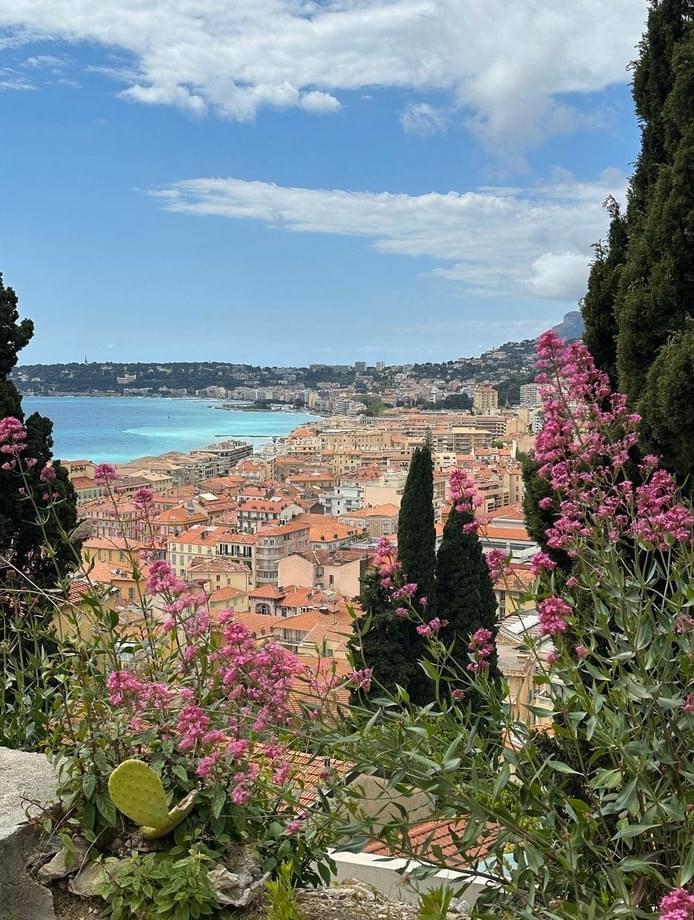
This is Eze-Bord-de-Mer taken from Eze Village.

and this is David Niven’s house between Beaulieu and Saint-Jean Cap-Ferrat.

It was another beautiful sunny day and I spent a few hours sunbathing and enjoying our pretty balcony. As soon as the sun goes behind the mountain the temperature drops considerably.

Here are the rest of the French holidays…
Other famous French traditional celebrations
Epiphany – Épiphanie or Fête des rois : January 6
Epiphany commemorates the visit of the Three Kings, or Magi, to the infant Jesus. In France, the date is less important than the tradition that goes with it.

In France we have a tradition of the Galette des Rois, the kings' cake, which is made of flaky dough stuffed with almond cream. It has another peculiarity − a hard bean (a fève) or other small object will be hidden inside, and the person who ends up with the item will be king or queen for a day. This involves wearing a golden paper or cardboard crown, which is usually included with the galette.
There is a tradition whereby the youngest child will hide under the table and call the names of those receiving a slice of cake, just to keep things fair, of course.
The tradition of the galette could date back to Roman times, during the Saturnalia (the week-long Roman feast held in honour of Saturn). Owners and slaves would share a meal and the slave finding the fève − a gold coin − would be king for a day. But this isn't confirmed...
The tradition was adopted by Christians during the Middle Ages to celebrate the Epiphany.
Candlemas – Chandeleur : February 2

Pancakes or crepes for Candlemas
Crêpes, the traditional Candlemas meal
This Christian holiday takes place 40 days after Christmas and celebrates the purification of Mary after childbirth and the presentation of Christ in the Temple.
For many people, though, it is better known as Pancake Day, or "Jour des Crêpes", and of course there are traditions (or superstitions) attached to it. Here's one: hold a coin in your writing hand and your crêpe pan in the other, and flip the crêpe; if it falls back into the pan, you'll have a great year.
Candles were traditionally blessed at this festival.
Valentine’s Day – Saint-Valentin : February 14

This is one of those holidays which is gaining ground although Valentine's Day in France isn't celebrated in any specific way. We do give our loved ones flowers or chocolate, but we don't exchange cards with friends and acquaintances.
There is some resistance to the holiday, however, which many French see as overly commercial and a bit of a marketing opportunity designed to part you from your money. Still, French Valentines Day traditions are on the rise.
Mardi Gras : February or March

It may have started as a pagan tradition celebrating the end of winter, but like many of these French traditions it was absorbed into Christianity. It also happens to be the last chance to indulge yourself before the ritual fasting of Lent.
The celebration is known for its masked balls, which made their first appearance in the 13th century. This anonymity allowed guests to adopt a new persona for the night and leave their reality behind, whether social class or family ties. Over time, the disguises came to symbolise a certain level of freedom.
Head for one of the more colourful and famous French carnivals − Nice, Paris, Dunkirk, Annecy, Mulhouse...
April Fool’s day – Poisson d’Avril : April 1

Yes, France does celebrate April Fool's Day.
In French it translates as "April's fish", a term that has many stories of origin. As children, in its simplest form, we April fools would cut out a fish from coloured paper and stick it surreptitiously on someone's back, laughing when they realised what was stuck on them as we shouted "Poisson d'Avril"!
In one version, the name comes from the start of the fishing season, but with such few fish this early in the season, this turned into a prank: if someone managed to convince you they had caught a fish, you were the fool. In another version, "poisson" is a corrupted version of the word "passion", which refers to the Easter season. And there are many more stories.
Additional French celebrations in France today
The Saturday nearest 18 May: Night of the Museums, during which they are open late into the night and stage a huge variety of events.

Last Friday in May: Fête des Voisins,

Neighbour's Day, celebrated in many parts of France to bring neighbours closer together − it often involves neighbourhood parties or bringing food for collective meals
Last Sunday in May: Mother's Day
21 June: Fête de la Musique for the summer solstice, with music happening all over France, from official venues to bar bands and dancing in the streets

Third Sunday in June: Father's Day
3rd weekend in September: Journées du Patrimoine, or European Heritage Days, is one of the major French cultural events, when historic buildings you never enter otherwise are open, like the Elysée Palace, where France's President works.

Journee du Patrimoine
For a weekend, thousands of sites open their doors, including places that are normally inaccessible or rarely open to visitors. You might find yourself touring a private mansion, visiting a government building, going behind the scenes at a railway station or exploring a small local site that isn't normally on the tourist circuit.
The event began in France in 1984 and has grown massively, with events in cities, towns and villages throughout the country. Some visits are free, while others require advance reservations, and the programme changes every year.
If you're in France on that weekend, check the local programme — some of the most interesting openings are places you would never otherwise know you could visit. (The French government has a rather unwieldy website in French with listings each year.)
Sometime between the end of September and October:

the désalpe, a traditional Alpine celebration that marks the return of cattle from summer mountain pastures. Expect flowers and cowbells and festivities, usually in the French Alps, but check because dates vary
31 October: French Hallowe'en traditions are relatively new

Trick or Treat is not an established custom, and the holiday spirit is more one of supermarket alleys filled with disguises.
3rd Thursday of November: Beaujolais Nouveau is released.

December: Christmas markets all over France



Comments
Post a Comment