Day 3388 (Friday) 18th September 2026
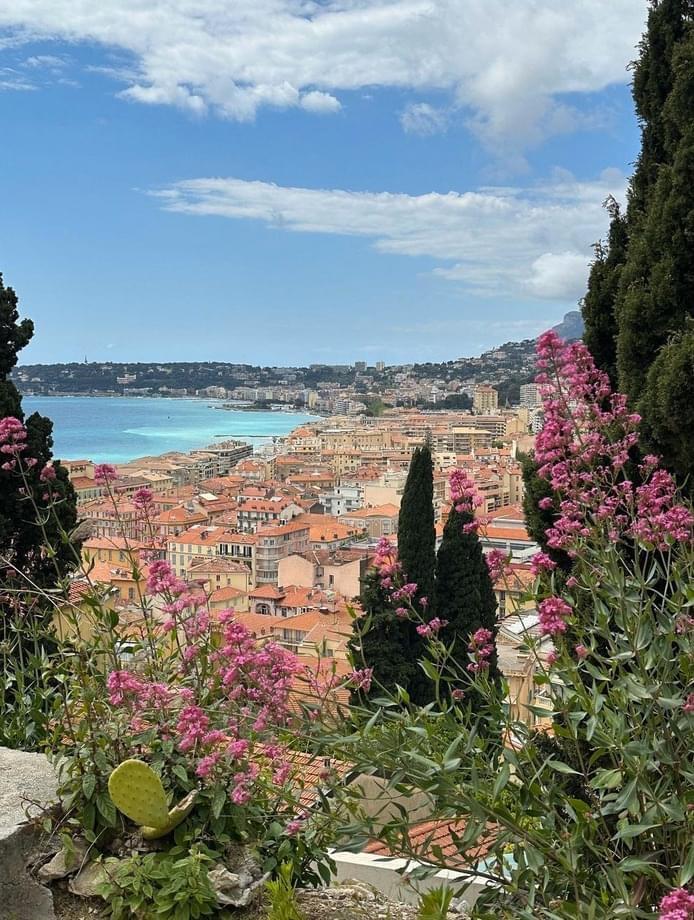
This is Villefranche-sur-Mer

and this is Saint-Jean Cap-Ferrat

The weather was perfect for sunbathing today - no humidity and lovely and warm. We did a few chores around the flat and then had a lovely lazy day. We’ll go to Le Phare later so hopefully there will be some friends there.
Here are the rest of the funny phrases…
Other Funny Phenomena in the French Lexicon
1) Words ending in three Es
words ending in three e’s such as the feminine past participle of the verbs créer, agréer, suppléer
Thus, we would write the following:
J’adore les robes que Gaultier a créées. (I love the dresses Gaultier created.)
Les expressions agréées sont une forme de politesse. - (Standard phrases are a form of politeness.)
Il faut que ces tâches soient supléées par les ressources plus vastes. (These tasks must be supplemented by more extensive resources.)
2) Words that are feminine in the plural and masculine in the singular
After learning all about gender distinction in the French language, you will be thrilled to learn that the following nouns change genders, depending on whether there is one or more of them: amours, délices, orgues. (loves, delights, organs.) Thus, we say amours enfantines, (amours enfantines) but amour éblouissant ; belles délices,(dazzling love; exquisite delights,) but délice somptueux ; orgues mélodieuses, (sumptuous delight; melodious organs) but grand orgue (main organ).
3) The word gens
Although only used in the plural form, this word resembles the preceding words in that it sometimes takes on a feminine role and sometimes takes on a masculine role. According to the Académie Française, this is due to its feminine etymological background, coupled with its expression of an idea that is considered masculine. Generally, prenominal adjectives that have distinct feminine forms are used in the feminine along with gens, while adjectives that appear after the word are used in their masculine form, e.g., ce sont de petites gens ; parmi ces gens nombreux. The prenominal feminine adjectives that appear along with gens do not extend to other components of sentences in which they appear, with the exception of toutes and quelles when used alone or with feminine prenominal adjectives, e.g., ces vieilles gens sont heureux ; toutes bonnes gens ; quelles belles gens! With other adjectives the masculine form is used, e.g., quels honnêtes gens ; tous les jeunes gens. Used with a complement introduced by de designating a quality, profession, or state, the preceding adjective will be masculine, e.g., tous gens de lettres ; les grands gens de bonne volonté. (No, I don’t get this one either.)
4) où
There is one word in French that uses u with the accent grave – où. It is thus distinct from the conjunction ou. The letter u is more often seen with a circumflex or tréma, e.g., dû, capharnaüm.
Funny French Expressions
1) l’esprit de l’escalier
Do you ever find yourself coming up with the perfect comeback – ten minutes after your conversation ended? This is an example of l’esprit de l’escalier, which the twelve-year-old narrator of Muriel Barbery’s L’Élégance du hérisson describes when she talks about not finding the right réplique at the right moment, but after too much time has elapsed. Her BFF, however, comes up with snappy responses right away, which is something Barbery’s narrator admires about her.
2) chercher la petite bête
There are those who love to split hairs, fixating on the most minute details and losing sight of, or directing attention away from, the larger picture. There is a moment in Yasmina Reza’s play Art when one of the characters accuses his friend of doing this very thing during a heated discussion over the significance of a completely white and very expensive canvas. When one friend asks how white lines are visible on a white canvas, the other, who is incensed by the enormous cost of the painting which to him looms over all of its other characteristics, says: “Tu cherches tout de suite la petite bête. Tu ne me laisses pas finir !” (You’re immediately nitpicking. You won’t let me finish!)
3) il y a quelque chose qui cloche
This expression conveys the idea of something being wrong, seeming incongruous, not sitting right. The idea of incongruity is present in the phrase from Michel de Montaigne’s essay De l’expérience, “tout exemple cloche”, which he uses to illustrate the singularity of a particular example, its uniqueness, even in its position as part of a larger category.
4) un froid de canard
This phrase is particularly useful in certain parts of the Northern Hemisphere, as it indicates an intense cold. The image comes from the hunting of ducks, who glide in and out of water easily, but not when it is frozen over, making them easier targets for hunters during colder periods. Speaking of fowl, how about this anecdote: “C’est une poule et un canard ; la poule dit au canard: il fait un froid de canard ; le canard dit à la poule : j’ai la chair de poule”. (There’s a hen and a duck; the hen says to the duck, “It’s freezing cold”; the duck says to the hen, “I’ve got goosebumps.”)




Comments
Post a Comment