Day 3387 (Thursday) 17th September 2026
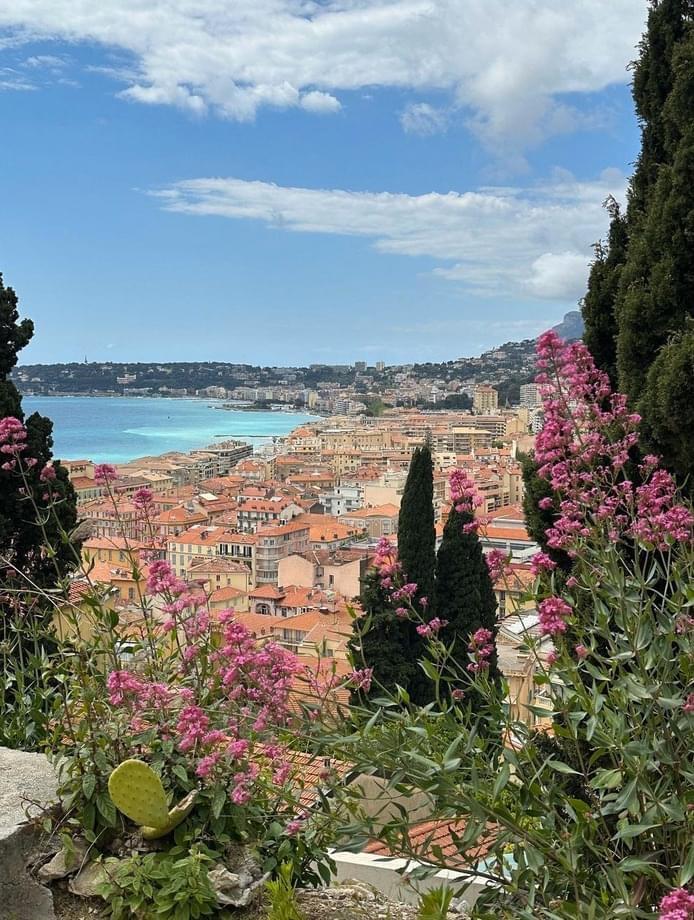
This is Nice from the sky

The white trails that planes leave behind are condensation trails, or contrails, which are artificial line-shaped clouds made of tiny ice crystals.

We walked down to La Darse because Huw had read somewhere that there was a regatta there and all sorts of entertainment. When we got there it was very quiet and it turned out that it’s all happening at the weekend for the 43rd European Heritage Days. We should have noticed this yesterday when I posted the Heritage Days article but we didn’t. Ah well we can always come back at the weekend. It’s a lovely walk down to La Darse along the citadel which is still covered with buoys as a work of art - it is rather lovely.


When we got there we were very lucky to get a table in La Baleine Joyeuse (The Jolly Whale) and enjoyed a nice lunch

As always it was a pleasure to see the pointus (traditional pointy fishing boats)


On the way home we admired this Chinese hibiscus

I found an article about funny French words and phrases which I found amusing, it’s quite long so I’ll post it over two days…
16 Funny French Words and Phrases that Will Make You Laugh
There are words and phrases that sound funny in any language, and French is no exception. If you are learning French, it's useful to know some funny French phrases. Did I mention the group of students who laughed their pointy heads off at the word deuil as they were adjusting to producing its vowel sounds? In this case, their anglophone twist on the sounds of the word played a role in how funny it was to them, but there are also French words and phrases that are funny to any person uttering them, whether or not they are native speakers. Some words seem to be deliberately funny, while others have just turned out to be amusing.
8 Funny French Words
1) abracadabrantesque
Remember the word abracadabra? It is used as an incantation for magic tricks and is spelled the same way in English and in French. In French there is a corresponding adjective, which means preposterous, exaggerated. Its definition in the Larousse appears as: “Qui suscite l'incrédulité par son caractère improbable ou incohérent : Une affirmation abracadabrantesque”. It’s good to have a six-syllable word for something so bombastic.
2) cerf-volant
This could be literally translated as “flying deer”, but is actually the translation for “kite”. I’m not sure if the form of many kites resembles deer, but perhaps the flighty movements of kites bring deer to mind.
3) pamplemousse
This is not mousse that you eat – pâté, chocolate mousse – but grapefruit. It seems odd that a fruit would have the name normally reserved for something prepared to have a smooth texture, but it is actually from the Dutch word pompelmoes – a big lemon – which explains the use of the word mousse in its French adaptation.
4) sardanapalesque
This is another adjective corresponding to a noun. The noun sardanapale has origins in the Latin word sardanapalus, which refers to a powerful man leading a luxurious life. The meanings somptueux, luxurieux, and princier doubtlessly draw from this image.
5) meugler
While the word moo in English seems more of an illustration of onomatopoeia, this French version involves a /g/ that seems a curious component of this sound made by a cow. But, having Latin roots in the verb mugilare, this is in fact the verb you would use to describe the sound a cow makes. You could say “Elle meugle” when referring to a cow, or “Meugles-tu ?” if you address a cow while petting it.
6) vachement
Speaking of cows, when you wish to emphasise something in French, you can use this word, as in the following sentence: “Le TGV est vachement rapide!” The question is, why do we say “cowly” for emphasis?
7) yaourter
To yogurt? First of all, the sequence of sounds involved in this verb is interesting enough, with two vowel sounds in a row that are distinctly French, followed by the French r, and an -er ending from the 1er groupe. The word denotes trying to speak or sing and floundering, especially in a foreign language. A side note to this term is that the singer Seal wrote in the liner notes of his eponymous 1994 album that he didn’t include the lyrics to his songs with his CDs because he wanted to encourage people to respond to the sound and feel of the music. This was obviously before the explosion of the internet and he liked the idea of people relying on what came to their ears to interpret his songs. But was he a yogurt fan?
8) machin
This is a synonym for truc. The English versions, whaddyacallit or whatchamacallit, are much less economical. If you momentarily forget a word, don’t feel like saying it, or simply can’t be bothered, you can say things like: “On utilise ce machin pour nettoyer l’écran”. One French woman I met even feminised it when she couldn’t be bothered to come up with people’s names: “Ils veulent tous bavarder juste parce qu’un Monsieur Machin sort avec une Madame Machine...” We were all laughing by the time she was finished speaking.




Comments
Post a Comment