Day 3378 (Tuesday) 8th September 2026
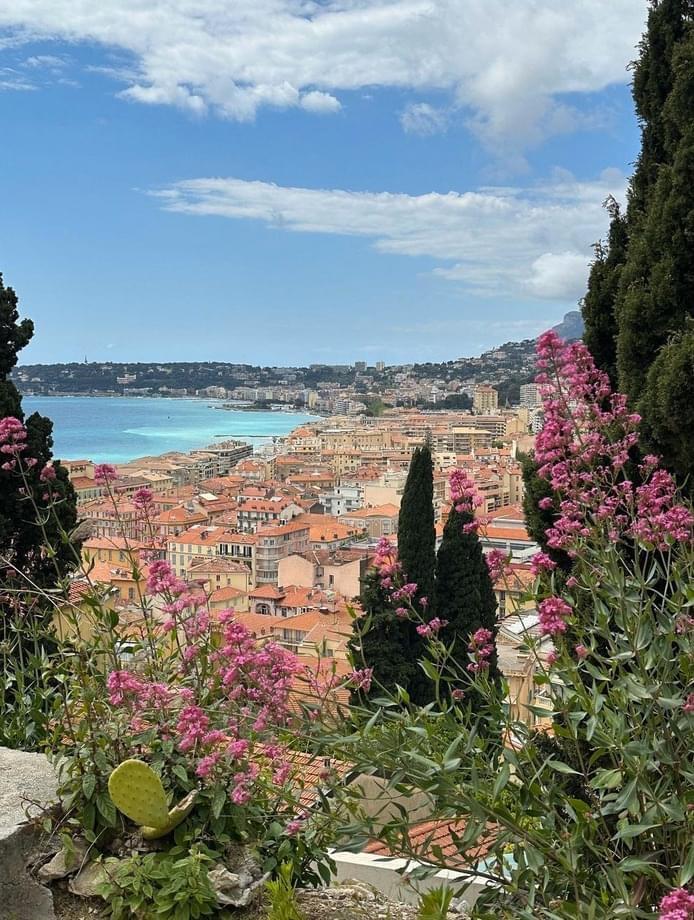
This is Menton

and this is Cours Saleya (flower market) in Nice.

it was yet another lovely sunny day with very little humidity and we went to Nice to enjoy our kebab in the park. The weather is just perfect at the moment, bright sunshine, blue sky and little humidity.

This bougainvillea is growing like a weed in the park while the one on our balcony is pathetic. Everywhere you look there’s bougainvillea, it grows out of walls in the train station and on the beach, in other people’s gardens, everywhere but on our balcony.

Here is the rest of the article about describing French people…
Stephen Clarke on the French. I love reading Stephen Clarke, he’s very funny, not as good as Peter Mayle but his books are really good.
Here are two quotes from the book A year in the merde, by Stephen Clarke, that I think characterises well the French mindset, especially in Paris:

[After his French boss told a "striking" café waiter that he didn't care that he was on strike and wanted his dessert]
«I was witnessing an important lesson in Parisian life. I mustn't try to make people like me. That's much too English. You have got to show them that you don't give a shit what they think. Only then will you get what you want. I'd been doing it all wrong, trying to win people over. If you smile too much, they think you are retarded.»
[page 96, complaining about the ubiquitous dog turds on the Parisian pavements]
«Well, yes, it kind of sums up the French philosophy of life. You only ever think about yourselves. Instead of getting together to stop dogs from pooping on pavements, you just learn how not to step in the merde.»
[page 38, leaving the office for lunch]
«We left the building at 12:30 with "bon appétit" ringing in our ears. The people who saw us called it out like you would say "Happy Christmas". Every lunchtime, it seemed, was a celebration. And why not?»
Lucy Wadham on the French (writer of the Secret Life of France)
In The Secret Life of France, Lucy Wadham largely confirms my description of French culture and mindset.
Compared to the English, she perceives the French as:
Theoretical, obsessed about ideas (as opposed to the pragmatic, factual English)
Conformist and conservative in term of clothing (unlike the eccentric Brits)
Formal and civil when it comes to language (whereas the English are polite but informal)
Relaxed in their attitude to time (a world away from Germanic punctuality)
She rightly points out that French humour is actually more wit, with a heavy use of puns. The Brits, in contrast, like to make fun of themselves (something the image-conscious French can't understand) and have an acute sense of comic, absurd and sarcastic humour.
Lucy Wadham writes that the French tend to prefer grandiose tragedy over comedy.
The French and English-speaking definition of freedom differs a lot, Wadham explains. For British or American people, freedom is linked to the sense of property and private space. Being free means owning your own house and having the right to protect it against intruders. I will add that "No trespassing" signs are indeed rare in French-speaking countries (or most of Europe outside the UK and Ireland). The French sense of freedom equates being freed from the burden of working so as to have free time to dedicate to one's hobbies and past times. This cultural difference is best illustrated by the attitude of the French vs British nobility in past centuries. While the French nobles had to leave their castle to attend the King's court in Versailles, the British aristocracy spent as much time (and money) in their castle as possible, because a big castle was the paragon of their status. Freedom for the French meant being able to enjoy your time as you liked, even if that meant staying at the King's court and abandoning their castle.
Gender roles represent another major cultural gap across the Channel. The Brits, like other Germanic and Protestant nations have become strongly feminist, giving rise to a strong tension between men and women. Men go out together, and women together, but the two groups do not mix much socially when they can avoid each others. France, like other Latin and Catholic countries, is just the opposite. Gender roles have not been shaken much by feminism in France, and society has consequently preserved a certain gender harmony, where men enjoy socialising with women and vice versa. Indeed, the French would be very bored without these constant male-female interactions and seduction games.
This relates to another primary cultural divergence. Aesthetics is one of the deepest French values. Beauty, elegance and charm are a national obsession. People have to be beautiful to be valued in France, however superficial that may sound to the British ears. In a society where both men and women put so much care (and artifice) about the way they look, it is only natural that seduction and gender roles should be of primordial importance.
Wadham writes : «Paris is all about Beauty. Everything else - including such things as commercial gain, prosperity or efficiency - is secondary.» She goes on saying that plastic surgery is five times as common in France as in Britain.
Seduction inevitably leads to sex, another French forte. According to a Durex survey the French are the nation where people have the most sex in a year. Wadham reveals a hidden facet of Parisian bourgeoisie that is much more difficult observe than other cultural aspects of France: adultery. The second chapter of her book is entirely dedicated to it, and the book's title makes a reference to what she calls the Secret Garden, in reference to the French saying that everyone is entitled to his or her jardin secret (meaning "secret love life"). She explains that adultery does not carry the same strong negative feelings as in the UK, or even Italy, and that the French accept it as an inevitable and necessary part of life, as long as it is kept discreet. She says that most married people have at least one secret lover, and that both husbands and wives expect their partner to have one - although they don't want to know about it. France is still a libertine nation.
This was a revelation even to me, as this part of French culture is not shared with Belgium, and maybe not that common outside the Parisian bourgeoisie. French-speaking Belgium would be much more like puritan Britain, I would say, where men and women are jealous and uncompromising about cheating. The figures speak for themselves; Belgium has the highest divorce rate in Western Europe just above Denmark and the UK.




Comments
Post a Comment