Day 3377 (Monday) 7th September 2026
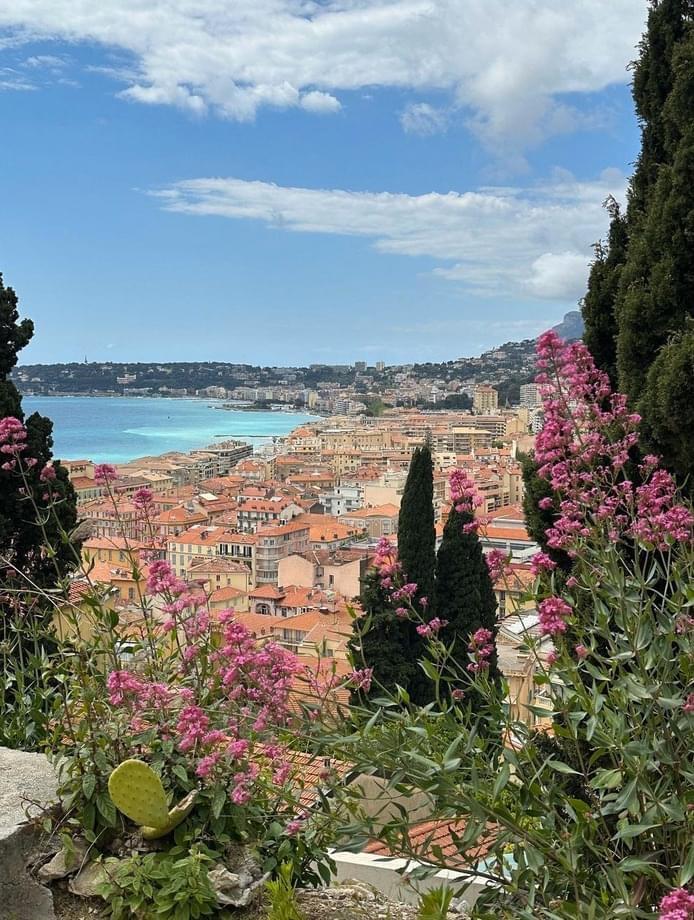
This is the exotic garden in Eze Village

and this is Villa Ephrussi de Rothschild.

Huw took this lovely photo early this morning, we have no idea what it’s all about but it looked great.

We went to Saint-Jean Cap Ferrat for lunch today and we shared a chicken burger, it was OK but the view is wonderful.

There was a new statue in the square outside the cafe, we weren’t exactly impressed with it but it’s interesting.

We also saw these beautiful flowers and according to my App they are called Chinese hibiscus.

On the way home we stopped in the garden centre to replace some of the plants that Badger has eaten, it wasn’t as full as usual but we did get some.


What makes French people so typically French?
1) The French like complicated things.
In a political debate on French TV, it was once said "In France it is simple to complicate things, but complicated to simplify them". This summarises to the perfection one of the fundamental aspects of French culture.
Illustration (quoting Richard Hill): «The American mistrusts complex things and tends to oversimplify. The Frenchman, by inclination and education, mistrusts simple things and tends to over-complicate. It is for this reason that no Frenchman, by American standards, can ask a simple, straightforward question when speaking in public. By French standards, no American speaker can give a full, sophisticated answer.»
Example : The Economist describes the French tax system to be of 'fiendish complexity'. They cite, for instance over 40 deductions in the French pay-slip, as opposed to just 2 in Britain.
2) The French are theoretical. They prefer rhetoric, abstractions and ideas to facts and practical thinking.
If Shakespeare had been a Frenchman, he would have said : "To be or not to be, that is the question. But the question is badly formulated."
The French favour design over practicality. They like innovation for the sake of creativity, even when there is no practical need for it. (incidentally, this is the polar opposite of the Japanese mindset).
The French raison d'être is "measured intellectual performance".
3) The French political dilemma : an autocratic egalitarian society.
They claim to follow the 18th-century Revolutionary values of "liberty, equality and fraternity" (written on coins, stamps, etc.), but France is actually one of the most hierarchical and vertical society in the Western world. The political and economical systems are extremely elitists. A few chosen ones study at the Grandes Ecoles (elite universities), then join the administration at a high-level from the start to "learn how the system works, and make connections", then become top executives in major public (or private) companies. There are very close ties between big businesses and the government in France, and executives are criticised for knowing better how the government and administration works, than how their own company does. This creates a huge gap between the top of the company and the rest.
French society and language are also exceedingly formal compared to most other countries.
4) The importance of forging relations.
Like the Spaniards, the French like to create relations with someone over a long lunch before starting making business with them. They need to get to know what kind of the person they are dealing with, and create an emotional bond.
Richard Hill: «Disregard for the customer is a way of life in the French business world. [...] Indeed, in French eyes, putting oneself readily at the disposal of a total stranger is an affront to one's self-esteem : like the Spanish, the French have difficulty in recognising the difference between service and servility.»
5) The decision-making process
French people (e.g. managers) typically make a quick decision that they might revise later on. This is the opposite of the Germans who think carefully about all the possibilities then make a decision that they will not change afterwards.
6) The râleur character
This also came up in debates on French TV. A Swedish journalist said that one of the first things he had to learn when he arrived in France was râler, a difficult term to translate as it is so typically French (the word doesn't exist with that meaning in Quebecois French), and which we could translate as "complain about all and everything, not always with justification". The Swedish journalist explained that he had never met people who complained more than French, anywhere in the world.
French people like to strike, protest or demonstrate to voice their discontentment, while the others complain about people striking and demonstrating...
One ironic example of the French râleur is the commuter in his car who complains in the traffic jam about the fact that other people have also decided to come to work by car : "Why don't they all come by public transports ?" In other words, they are never satisfied and don't try much to understand the other person's point of view.
André Gide, a French writer who received the Nobel Prize of Literature, said that "French people are Italian people in bad mood".
The French viewed by themselves
Here is something I heard on LCI (a French news and debate channel) and I thought was spot on:
«Paris is hell, but that's still the place where Parisians prefer to live.»
I have watched a popular weekly debate programme (called "Ça se discute") on a French TV channel with topic "Why do French people have such a bad reputation abroad?" The people invited to the debate where three Americans, one Irishman, one Pole, one Afghan and one Québecois, all living in France, and three French people living abroad.
It was a very interesting debate, and served as a good self-criticism for French people. Many agreed that the main defects of the French are that they are:
1) Argumentative and râleur. They mentioned that French people were not afraid to say what they thought, even if it led them into trouble. This is even true in politics (e.g. argument about the war in Iraq). No wonder that the adjective "frank" comes from "France".
2) Pretentious/arrogant/chauvinist (about their country and culture). This is especially true of Parisians. Many people tend to confuse Parisians for all French people. However, even the French themselves agree that Parisians are much more arrogant and unpleasant than average. Unfortunately, most visitors to France get their first (or only) impression of France in Paris.
3) Irrespective of rules and laws. The debaters mentioned that when a new law passed, an average French would determine him/herself whether it was reasonable enough to respect it. That is why even some police officers do not bother fining people smoking in non-smoking areas, if they disagree with that law, which is unthinkable in most of the English-speaking world.
4) Bad at speaking foreign languages. Especially English, although most English speakers cannot criticise them on this. More specifically, the French tend to be unfriendly to people who do not try to speak French - but so are people in English-speaking countries about English in my opinion. Once again, this is especially true of Parisians.
5) Dirty (e.g. dog turds in the street; no shower before sex...), while at the same time being elegant and charming.
Among the other, either positive or neutral things they mentioned:
1) The image of the French lovers - although many women interviewed agreed that it often meant a lot of baratin ("sweet talk") uttered too lightly. The three Americans also agreed that French people are much more open about sex than Americans. People are not ashamed to talk openly about it, or to display nudity at any time of the day on TV (in commercials, series, movies...). French men also flirt more easily with anyone in the street, and are generally not afraid to have their advances turned down or "lose" (no fear of being a 'loser' like in the US, or 'lose face' like in East Asian countries). Another interesting remark was that French women flirt less than American ones, and expect more initiative from men. One guy said that French women over 30 years old will rarely call a man if the man doesn't call them.
2) The relaxed and enjoyable lifestyle (the art de vivre). On this point, one American guy said he hadn't got used to French timetables yet. He explained that when you want to make a business phone call (especially to a government office), you shouldn't do it before 9.30 to 10.00 am as they only get started with their day and may be a bit grumpy or disorganised before that, but then not between noon and 2 to 2.30 pm as it is lunch time, and many place already close at 5 or 6 pm, which leaves little time available. On many points, French-speaking Belgians are like the French, and this one is no exception. Despite being a Belgian, I also found it difficult to adapt to this system after becoming used to live in punctual countries like Japan, the UK or Germany.
3) The importance of feelings over money in relationship The Americans agreed that in the US, no matter how good or sincere a person was, money typically came as a determining factor in a relationship, because people had to be "winners" with ambitions and money. They said it was normal to ask someone you were dating "how much money do you earn ?", which is unthinkable in France. People in France tend to hide how much money they make. In France, someone with a nice car get it scratched by envious people who think they'd deserve it too. Contrarily to the USA, in France people who succeed are not more respected.




Comments
Post a Comment