Day 3346 (Thursday) 6th August 2026
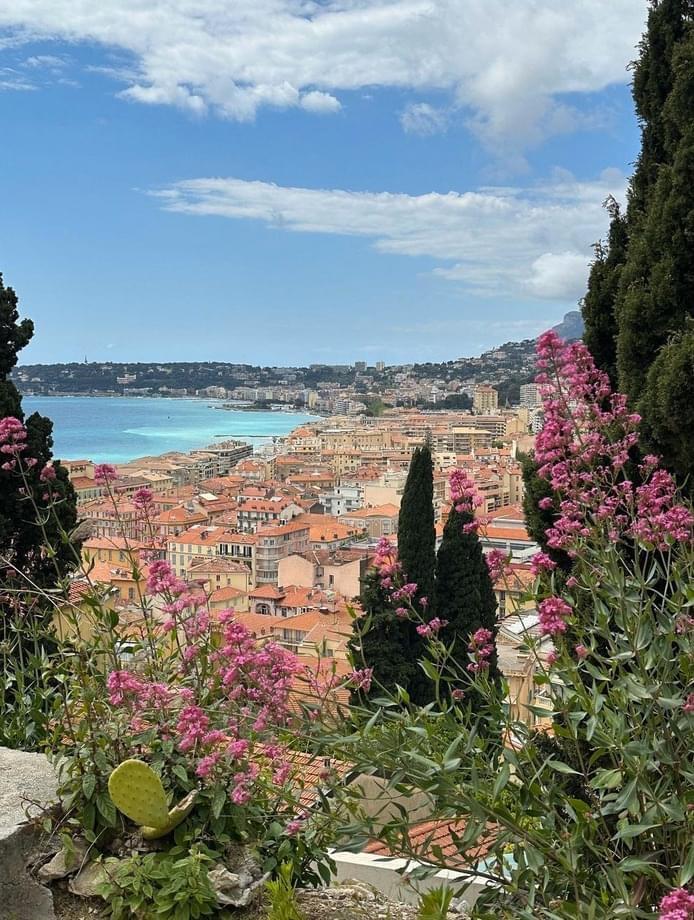
This is Villefranche-sur-Mer

and this is Monaco.

It was very hot and humid again today and we went to the garden centre in Saint-Jean Cap-Ferrat to get some new flowers for the balcony. It wasn’t as good as the last time we went but it was still pretty good. It was so hot in the glass house.


These were the ones we bought, Badger is going to love them.

There have been lots of wildfires in France lately and we’ve been very lucky to have missed them. Huw found this article this morning explaining why they’ve passed us by in the Alpes-Maritimes area…so far.
"We have had some fires. They were brought under control very quickly": why have the Alpes-Maritimes so far escaped the major fires that are ravaging the Var?
While wildfires have multiplied this summer in the Var, Aude, and Gironde departments, the Alpes-Maritimes department seems to have escaped the most devastating blazes so far. This impression is misleading. Since June 1st, 27 fires have been recorded. All were quickly brought under control.
As megafires have multiplied for several days in the Var, the Aude and the Bouches-du-Rhône, a question arises: how have the Alpes-Maritimes, until now, avoided a similar scenario?
Behind this feeling of calm lies a very different reality. Since June 1st, 27 forest fires have already been recorded in the department. The two largest, fires in inaccessible mountainous areas of the Tinée Valley, burned around 8 hectares before being brought under control.
“ We are absolutely not an exception ,” warns René Dies , departmental director of SDIS 06. “ We have had fires break out. They were simply able to be brought under control very quickly.”
None of these fires had time to reach a scale comparable to that of the disasters which ravaged the neighbouring department and those in the south of France in July.
This philosophy is at the heart of the French doctrine for fighting forest fires: to intervene quickly, decisively, and massively , by simultaneously mobilising air and ground resources. In the Alpes-Maritimes region , this strategy is applied with a particularly high level of response.
At every fire, three water-bombing helicopters are automatically dispatched. Simultaneously, 200 firefighters are pre-positioned daily in the most vulnerable areas to ensure immediate response. Thanks to this system, the first water drops can be made in just ten to fifteen minutes after the fire is reported. This level of response is made possible thanks to the financial support of the Department, which allocates 2.3 million euros per year to the provision of these three helicopters."The risk is slightly lower than in the Var region... but it remains very real."
For René Dies, the first explanation is beyond doubt: it is the operational organisation of the SDIS 06 that makes it possible to contain the outbreaks of fire before they become uncontrollable.
The director of the SDIS then mentioned a second factor: a generally lower risk level than in the Var , where conditions are often classified as "very severe" or even "extreme." In the Alpes-Maritimes, episodes of violent winds are generally less pronounced, and easterly winds can occasionally bring more humidity.
But that's where the difference ends.
“We share the same mountain ranges as the Var region, notably the Estérel and the Tanneron. We have the same vegetation.” In other words, the risk remains very real. Moreover, among specialists, the 2026 season is being compared to that of 2003. That year, devastating fires ravaged the area around La Gaude and Cagnes-sur-Mer.
" So we are certainly not safe from a major fire in the Alpes-Maritimes , " warns René Dies. "We still have almost two months to hold out ."
Force 06, an additional advantage
Beyond the resources of the SDIS, the department also benefits from the support of Force 06 , a system that René Dies considers a real asset.
Thanks to its network of cameras, smoke outbreaks can be detected very quickly. Force 06 also provides water reserves and large transport vehicles that allow water-bombing helicopters to resupply rapidly as close as possible to the intervention zones.
"Perhaps it is this extra something that helps us enormously , " emphasises the director of the SDIS.
Nine out of ten fires are linked to human activity.
Another lesson: nine out of ten fires are linked to human activity , most often accidentally.
Hence the importance of preventative measures, but also of clearing brush around homes.
René Dies emphasises a concept still little known to the general public: that of the "defensibility" of houses. "A house that is properly cleared of brush, accessible to emergency services, and far from any combustible vegetation has a much greater chance of being saved if a fire breaks out."
Despite a controlled start to the summer, the fire and rescue service's message remains unchanged: "the battle is far from over." A single careless act or a bout of strong winds could be enough to change the situation.
Two mountain fires in the Tinée valley proved difficult to control in July.
The Alpes-Maritimes region has not been spared from fires this summer. Among the 27 fires recorded since June 1st , two were particularly significant, with areas burned exceeding ten hectares.
They occurred in the Tinée valley, in the municipalities of La Tour-sur-Tinée and Roubion. Their particularity: they were not caused by human activity, but by lightning strikes , during storm episodes that occurred exceptionally early in the season. These fires took a particularly long time to extinguish due to the terrain. Starting in steep and difficult-to-access areas, with no immediate access to water sources, they required significant fieldwork carried out jointly by firefighters and forest firefighters from Force 06.
"These are long-term projects, where you have to work with forestry equipment, pickaxes and transport water with heavy equipment ," explains Damien Giribaldi, head of Force 06.
These interventions are very different from fires that can break out in more accessible areas of the coast or the mid-country, where rescue services can quickly launch a massive attack thanks to the proximity of ground and air resources.
George and Amal Clooney have evacuated their 425- acre estate in Provence as fast-moving wildfires threaten parts of southern France. The property, known as Domaine du Canadel and located near Brignoles, serves as the couple's primary residence and sits just minutes from Brad Pitt's Château Miraval.




Comments
Post a Comment