Day 3344 (Tuesday) 4th August 2026
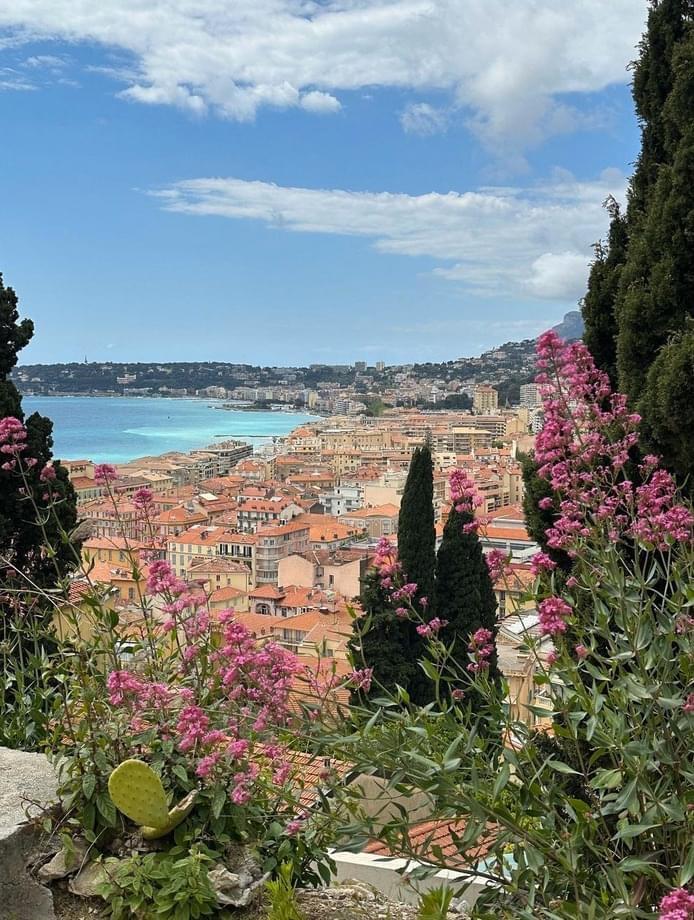
This is Eze Village again

and this is Monaco.

It was quite cloudy this morning but very, very hot and humid. There was yet another cruise ship in the bay and there were tourists everywhere.

We went to Nice on the scooter and thoroughly enjoyed our weekly kebab. It was very windy in Nice and this was great fun for the kids and dogs playing in the mister machine.

Here are some more interesting facts about France…
7. There are over 1,600 different cheeses in France
To say we French are obsessed with cheese is an understatement, and when you have as many creamy and delicious options as we have, it’s hard not to see why. There are just about 1,600 varieties of cheese in France, all grouped into 8 distinct categories:
Fresh cheese: Not aged at all, usually very soft in texture and mild in flavour. Think ricotta or feta.
Bloomy Rind cheese: Soft creamy cheese with a mould rind that keeps it all together. Think brie or camembert.
Semi-soft cheese: The best cheeses for melting into dishes. Think reblochon or raclette.
Washed Rind cheese: Like Bloomy Rind cheeses, the cheese is ripened from the inside out. However, the mould is not allowed to bloom and instead washed, and instead a sticky orange bacteria grows. Think langres and epoisse.
Semi-hard cheese: These cheeses are aged and get their flavour depending on the bacteria they’re fed. Think comté or tomme de savoie.
Blue cheese: These cheeses are injected with mould on the interior to create a blue vein-like pattern. Think roquefort or blue d’auvergne.
Hard cheese: Cheese that is extremely low in moisture and has a crumbly texture. Think cantal or esquirrou.
Stretched-Curd cheese: An Italian style of cheese, these are pulled and stretched and typically soft. Think mozzarella or burrata.
France produced 1.77 million tonnes of cheese in 2024.

8. French people consume around 20 litres of wine a year per person.
What goes great with cheese? Wine of course. And wine is obviously something the French excel at as well. According to studies, French people individually consume around 22.5 litres of wine a year per person, amounting to an estimated number of 1.02 million hectolitres in the country.
The country’s wine consumption has decreased significantly in the last 10 years however due to health advisors prompting people to watch their alcohol consumption.
9. Croissants were actually invented in Austria.
Perhaps more a fact about Austria instead of a fact about France, but it’s true. Croissants are part of a style of pastry called ‘viennoiserie’ which hails from Austria. The style was brought over in the 1800s and quickly became a popular favourite. Plenty of other French pastries are actually French, though, so don’t fret.

Image source:Contiki
10. France’s motto is pretty epic
Many countries around the world have very cool mottos which define them, but none defines a country as well as France’s: ‘Liberté, Égalité, Fraternité’. This translates to ‘liberty, equality, fraternity’ and it speaks to the country’s rebellious heart and history, which persists to this day. The motto was coined during the time of the French Revolution between 1789 and 1799 and it has remained today, found on stamps and coins and official government documents and buildings. It’s often found alongside a depiction of ‘Marianne’, a woman who symbolises the triumph of the Republic over the Monarchy.
11. France is home to the longest beach in Europe
With over 100km of beach, France’s Côte d’Argent is considered one of Europe’s longest beaches. Located right at the bottom of France’s Atlantic coast, right near Spain, this coast is filled with sandy beaches and glittering ocean. The area is great for surfers and the Landes area is the most famous, surrounded by forests for some really unique landscapes.

Image source:Andréa Villiers / unsplash
12. 17,000 people were executed using the Guillotine.
When a country is as old as France is, there’s plenty of fun facts to be found in its history. But perhaps one of the most memorable (and grisly) moments of France’s history is the French Revolution in a time known as the Reign of Terror. This period was one of intense violence between 1793 and 1794 as the people sought a revolution against the monarchy. This culminated when King Louis XVI was executed by guillotine and became the last king of France.
During this time, the guillotine was a threat that resided in town squares. A sharp angled blade catching the sun and solemn wooden posts creating the framing. If you were suspected of opposing the revolution in any way, execution was swiftly handed out. It’s estimated that between 17,000 and 22,000 people were executed by guillotine.
13. The French army was the first to use camouflage in 1915
Another historical fact about France, the French army during World War 1 was the first to create a dedicated camouflage unit. Army uniforms as well as guns and vehicles were painted in the camouflage style by a dedicated team, and a year later this strategy was adopted by the British. The word camouflage actually comes from France.
14. France has the most Nobel Prize winners in Literature.
This fun fact may not be surprising to some as France’s literary history and culture is very long and rich. I mean, the Enlightenment period happened in France as well, with philosophers and authors becoming some of the most famous and influential thinkers in the modern world.
But yes, 16 French individuals and/or French language authors have won the Nobel Prize in Literature. Essayist Sully Prudhomme was the first to win the prize in 1901 (when the first ceremony was held) and he was followed by: Frédéric Mistral, Romain Rolland, Anatole France, Henri Bergson, Roger Martin du Gard, André Gide, François Mauriac, Albert Camus, Saint-John Perse, Jean-Paul Sartre, Samuel Beckett, Claude Simon, J. M. G. Le Clézio, Patrick Modiano, and most recently Annie Ernaux (the first and only woman of this list).
Fun fact - Jean-Paul Sartre famously refused the award. He was married to one of France’s other very influential authors Simone de Beauvoir, and he was a student of Marxism and Existentialism.
15. France is home to Europe’s highest mountain
Famously the Alps span through a rather large portion of France, and in this portion sits the Mont Blanc which is not only the highest Alpine mountain but also the highest mountain in Europe. It is 4,806m tall (15,777ft).
This fact can be contested, however, if you count Russia’s Mt. Elbrus (5,642m) as a part of Europe or not.

Image source:Andrea Caramello / unsplash




Comments
Post a Comment