Day 3343 (Monday) 3rd August 2026
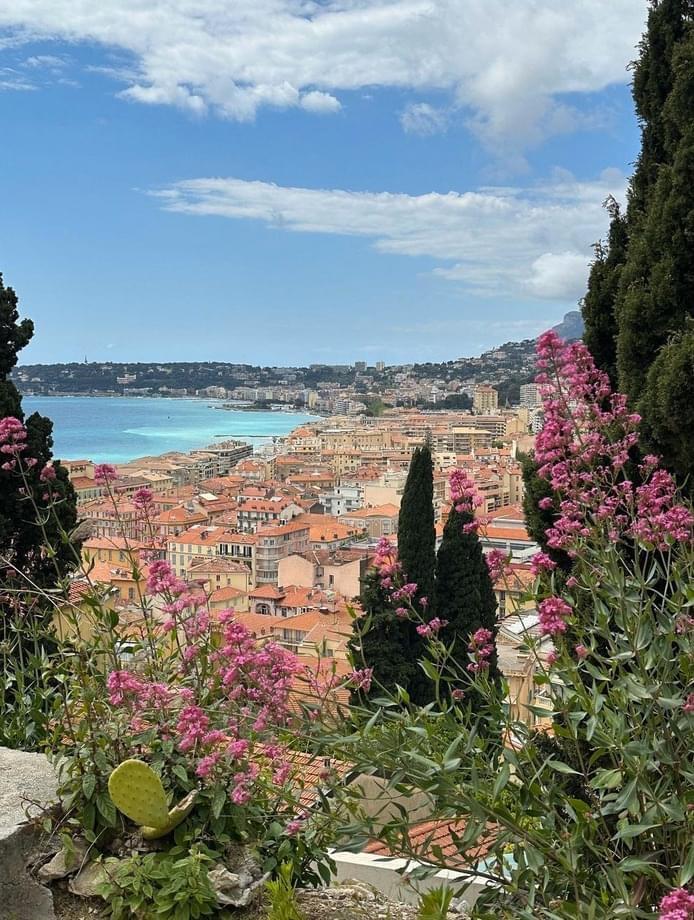
This is a very interesting shot of Eze Village

and this is the garden of Villa Ephrussi de Rothschild in Saint-Jean Cap-Ferrat.

It was very hot and humid again today and there was yet another cruise ship in the bay.
As always on a Monday here’s What’s happening in France this week. The Local France.

It’s August in France – that means it’s peak festival season.
Monday
Heatwave – After a brief respite on Friday and Saturday, the fourth heatwave of the French summer is expected to peak on August 3rd, though a fifth cannot be ruled out in the first half of the month.
Tuesday
Summer sales – They have been over for a week in much of France, but the summer sales officially end in Corsica on Tuesday.
Thursday
Puppetry in motion – If puppets are your thing, MiMa — the International Festival of Puppet Art, held from August 6th to August 9th in the medieval town of Mirepoix, Ariège — is for you.
Friday
Travel trouble – Roads watchdog Bison Futé has flagged every weekend of August as having ‘very difficult’ or ‘extremely difficult’ conditions on the country’s roads as holidaymakers head out – and home. Conditions this weekend won’t be as bad as they were on the chassé croisé of July 31st to August 2nd, but traffic conditions are expected to be ‘difficult’ or ‘very difficult’ over the weekend.
Fête de l’Ail Rose – The tiny Tarn village of Lautrec, birthplace of artist Henri de Toulouse-Lautrec, is also the spiritual home of pink garlic (the eponymous ail rose of the fête).
On the first Friday and Saturday in August, it hosts its annual garlic festival. The garlic soup is surprisingly delicious.
History retold – Between August 7th and 10th, some 6,000 years of history are told from the perspective of the Bridiers site, on which a ruined castle stands, in the Creuse commune of La Souterraine, is told annually in a spectacular show involving hundreds of volunteer performers.
Sunday
Bicycle Race – The Women’s Tour de France reaches its conclusion in Nice.
I found this article about interesting facts about France, it’s a bit long so I’ll post it over a few days…
25 interesting facts about France to inspire your next trip by Charlie Fabre
France is so much more than just Paris, cheese, and croissants (though these are all excellent and something we’re very proud of). The country is steeped in rich history – it’s been an influential hub in Europe since the country’s founding. It’s a place of culture, fashion and art. There’s honestly so much to learn about France in and out of your travels, and we’re going to share some fun facts about France that may surprise you and inspire you to visit.
1. France is called “‘L’Hexagone” (the Hexagon)
Why? Because it’s hexagon shaped, of course. If you look at a picture on the map, you’ll notice that France’s borders are fairly well defined with six ‘straight’ lines. Of course, the nickname rather simplifies the country’s actual shape, but the Dodecahedron doesn’t sound quite as good.
The nickname is widely used throughout France, and it’s actually used in schools in geography classes for children of young ages to learn to draw the country.
2. The Eiffel Tower was not meant to be a permanent structure
Though it’s perhaps the most iconic attraction in France today, the Eiffel Tower was actually never fated to become that. It was built in 1889 by Gustave Eiffel to be the centrepiece of that year’s Exposition Universelle – a fair meant to showcase scientific, technological and cultural achievements – and it was meant to be dismantled in 1909.
Why did it remain? Because turns out it was actually pretty useful when it comes to emerging technologies of the 20th century, including radio. It’s a good thing it stayed as well because the Eiffel tower today brings around 7 million tourists a year.
3. French is the official language of 29 countries
Does a fact about French count as a fact about France? We think so. You’ll know France as the beautiful language of love, filled with ‘ooo la las’ and ‘hon hon hon’ (we don’t actually say that), but did you know it was so widespread? The French language is also the second most geographically widespread language after English.

4. French gastronomy is a UNESCO World Heritage
If there’s one thing you probably already know about France it’s that the food is delicious and very highly regarded. So much so that French Gastronomy was awarded UNESCO World Heritage status in 2010. This is in part due to the rich history behind French cuisine and the influence it has had on many other cuisines, but it is also because of the social and cultural impact food has in France.
In France, a meal is so much more than just that. Oftentimes we will spend hours at the table chatting and drinking. If you ever spend a Christmas with a French family expect to be seated at the table from 1pm to at least 5pm. This just emphasises the way food brings people together in France and reinforces social ties.
5. Putting a baguette upside down is considered bad luck.
A pretty quirky fun fact about France is that you should never place a baguette upside down. I mean baguettes are pretty sacred to us in general, but the superstition stems from the Middle Ages when public executions were common.
Executioners used to leave their bread in bakeries when their gruesome duty called, and bakers would distinguish their bread from other loaves by placing the baguette upside down. Pretty soon, this ended up being associated with executioners and therefore with death and misfortune. So, if you don’t want to attract any bad luck on your travels, make sure to keep your baguette ridge side up.

Image source:Bas Peperzak / unsplash
6. French people open Christmas gifts on the 24th of December
Christmas is celebrated differently around the world, and in France the focus for the holiday is usually on the 24th for ‘Le Réveillon’. This can be different from household to household, of course, but traditionally families stay up eating and playing games and listening to songs, and at midnight gifts are exchanged. Then, on the 25th, everyone wakes up, wishes each other a Merry Christmas, and generally wider family members will come visit and we all sit down for one of those 5 hour meals I was talking about.
Usually families with younger children might opt to just open gifts on the morning of the 25th, but opening them on the 24th is France’s main tradition.




Comments
Post a Comment