Day 3327 (Saturday) 18th July 2026
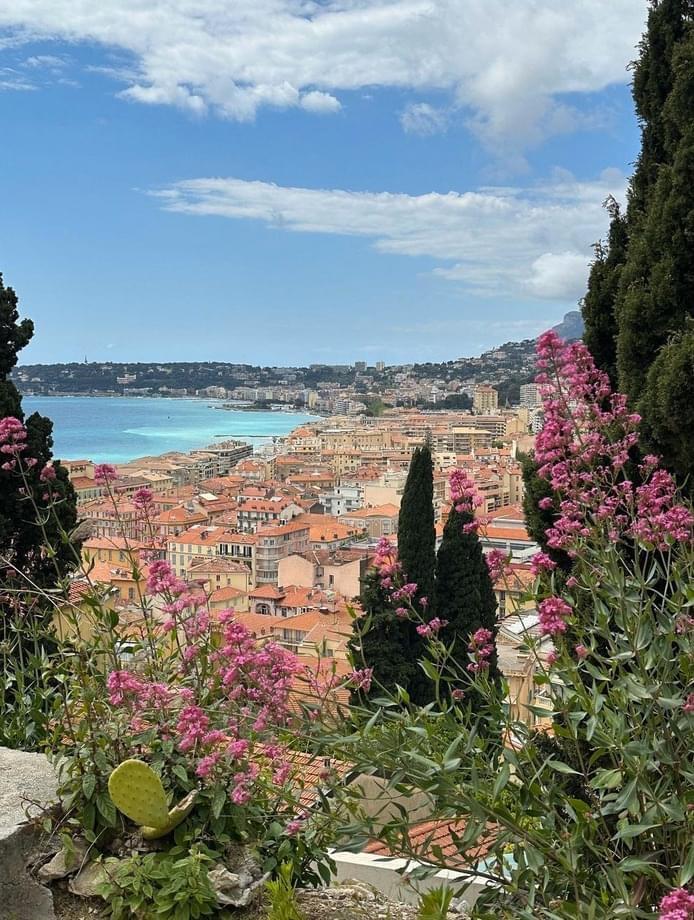
This is Eze Village

and this is a Jacaranda tree in Nice.

I forgot to mention yesterday that Elton John is in town and we saw him boarding his boat Hercules 11
and we saw him coming back in, he seems like such a nice man, very unassuming and normal.
There was yet another big cruise ship in the bay again today.

Pat phoned Huw and invited us for lunch in the square and we happily accepted. We had a beer in
Les Palmiers first and then went to Cosmo. There are new owners of Cosmo and thanks to the new
major they are allowed to spread the furniture into the square and it looks great.

I had a chicken burger, Huw had fish and chips and Dee had salmon - I can’t remember what Pat had.
The burger was enormous.


Here are the rest of the strange French habits…
How to be French; Weird French Habits

In How to be French part I, we looked at things like dunking your croissant in your coffee, cheese etiquette, the French obsession
with wearing scarves and talking – a lot. Plus heaps more things that make the French so French. In How
to be French Part 2, Janine Marsh, author of How to be French: Eat, drink, dress, travel and love la vie Francaise, reveals some habits that are unique to France, fun, and sometimes just a little bit weird – but not to the
French. Well ok, maybe even to the French sometimes just a little bit odd…
Weird French habitsNow I could mention things like couilles de mouton, sheeps testicles. In Dordogne they like to make something called frivolités beneventines. A big bag of, well, testicles which are peeled, soaked in cold water for three hours, sliced, and then
grilled with lemon, parsley and white wine. Have I had them? No. So I can’t say that they are horrible.
Would I eat them? Not if I can help it. Or how about andouillette – a sausage made with pigs intestines
flavoured with pepper, wine and onions and which has a frankly disturbing smell. Makes me think of
when I was young and we used to chant ‘yum yum pig’s bum.’ The smell is nightmarish actually. But
I’m going to start with something sweeter – sort of.
Raw beef sweets – anyone?
Pastilles de musculines! They’re so French it might be that most people have never even heard of them.
And they are sweets. But they are a bit different from your usual sweets. They’re made in Burgundy at
the Notre Dame des Domes Abbey. And the ingredients are quince pear and orange jam, honey, sugar
and – raw beef.
They are not like the number one sweet in France to be honest. But it’s said that they give you energy,
especially if you eat them before you exercise. They’re made from a recipe developed by a professor
and a doctor at the medical university of Montpellier and given to the monks at the Abbey.
Swimming trunksLet’s move away from food for a minute, maybe not for long because this is France after all, and talk
about swimming trunks. Yes you heard that right. Swimming trunks, swimming suits, bathing trunks,
swim trunks whatever you like to call them – the bathing outfits worn by men in the swimming pool.
And at the same time let’s talk swimming caps, those rubber hats that you have to yank over your head,
and try and stuff your hair in so that you look like Jiminy Cricket on a bad day.
So let me explain. In France, it is the law that men must wear tight fitting trunks in public pools. None of
that baggy surfer dude stuff here non non but the type sometimes referred to as budgie smugglers and I’ll
leave that there.
It is also required that in pretty much most public pools, everyone must wear a rubber bathing cap.
Even if you haven’t got hair.
Believe me – this is not a good look. You may be thinking Daniel Craig emerging from the ocean in
his famous blue swimsuit in Casino Royale – the reality is somewhat different in French swimming
pools. Now imagine him wearing a rubber cap – hmmm – not quite so good. But yes, in France we must
all don these hideous things in the public pools.
You don’t have to wear them on beaches by the way, or in private pools like hotels – it’s only municipal,
public pools. If you’re packing for a holiday in France – no need to rush out and buy a new costume and
a matching rubber hat. And you can actually buy the rubber hats at swimming pools from a vending
machine.
I thought this was very unusual when I first went swimming and had no idea of the rules. I emerged
from the changing room without a rubber hat, jumped into the water, and was told by a guard to get out
and go to the vending machine in the reception area to sort myself out.
Basically – they say – this is about hygiene. If you can wear the baggy shorts out on the street – you can’t
wear them in the pool. And officially it’s also about public welfare and reducing the chance of pollution
in the water – hair, sweat etc from wearing clothes maybe all day. And the same with the rubber head
cover – it’s to stop your hair from going in the water.
But you still have to wear the cap if you haven’t got any hair. Democracy and solidarity say the French.
A friend in Paris told me that he didn’t know the rules and he went to a pool early one morning and
jumped in wearing his Mark and Spencers long baggy shorts and the pool attendants staring blowing
whistles, shouting and tried to fish him out with a long hook.
It’s a law that goes back 120 years when municipal pools first became popular in France and, often it
comes up for discussion in the French senate but it never gets approved. Very French.
French people are never wrong
This is one habit that for me is uniquely French and yes, just a little bit off the wall. So, I was recently
on a tour in the north of France where I live, I take the train everywhere in France as it reaches
everywhere and is easy. But this time I went local and there were a group of us, a small group on a
coach doing a foodie tour – because the food here in Pas-de-Calais where I live is absolutely amazing.
And the tour leader told the coach driver to go down a little road to get to where we needed to be.
The coach driver said that the SatNav told her not to go that way. The tour guide insisted. And we go
down the road and there’s a low bridge and the coach can’t go under it and we have to reverse up a main
road to get out of the situation. The driver was a tad peeved about this and said “oh dearie, dearie me,
whoops a daisy” or words to that effect. She was British too so you know, a bit more colourful in her
expressions.
We all looked at the tour guide who said “J’ai rien dit” which, and I know this because I speak enough French to fully understand that sentence, so it means “I didn’t say anything.” So I said, yes you did, you said to go down that street. And the tour guide said “Oui, mais je me suis trompé” “yes, but it was a mistake.” In all the time I have been here, I don’t think I’ve ever heard a French
person admit to being wrong and the way round it is simply to say, if you’re French “J’ai rien dit” and that takes the wrongness away. Apparently.
Unfortunately for the tour guide, we were all British on the tour and we are always wrong about
everything (I am not going to mention Brexit), and we like everyone else to be wrong too. It was a battle
of wills. We lost. But we knew.
It is impossible for a French person to be wrong. French people drive on the right side of the road, eat
cheese after dessert and don’t apologise. British people apologise for everything “sorry it’s raining today. Sorry I trod on your foot on this packed bus where I don’t have room to put my foot down. Sorry I just rammed you with my trolley in the supermarket”. In France, if someone breaks their mother’s favourite ornament by accident, burn dinner and has nothing to serve guests, or turns up really late – they never say sorry. And if they say ‘take this turning here’, and it’s wrong, yes they simply say “I didn’t say anything!”
Queuing in FranceFrench people seem to have no concept of queuing. In fact no one in France appears to have been taught
the art of queuing. We in Britain are masters of the skill. We will queue for many hours if need be, it is
a national point of pride that we can stand in a line and wait our turn. If we know we are going to have
to queue for a long time, it doesn’t put us off at all – we take a flask of tea and that will get us through
anything.Now, let’s look at France.
French people do not like to queue.
Once, me and my husband went to a summer fete in the town of Fruges near where we live. There was
to be a hog roast in a big tent for lunch, but the roasted pig caught fire. Now, this being France, we were
not evacuated from the tent but were given glasses of strong rum punch as we watched the pompiers, the
firemen, put the fire out. It wasn’t very big.
So – rum punch plus a blazing hot tent and a late lunch. What do you think happened when a voice came
over a tannoy announcing we should head to the buffet table to be served?
Here’s how it went down. We walked to front of the tent to queue to be served our lunch. I’m under 5
feet, he’s 6 feet 4 inches, we look like the Crankys. We’re ready to queue. But no, that’s not what
happens. Grown men and women fought with each other to get to the front. Jean-Claude, my neighbour
and our table companion, dragged Mark with him, dead-legging anyone who got in the way, pushing
Mark in front of him as a human battering ram.
Me, I was forgotten about, no use to him to get to the front of the queue. The servers practically threw
the food onto plates trying to clear the rabble from the front. Afterwards everyone sat very politely as if
nothing had happened.
One of those “j’ai dit rien” – I said nothing, or rather in this case I did nothing situations.
French people don’t like queuing on the roads either. They hate to be in a line of traffic behind a tractor,
they want to be free!
Funny enough, when driving, the hand gestures used in the UK seem to be just as well understood in
France.
Weird French foodAnd now, because this is France, let’s go back to food. It is pretty much the law to talk about food here.
We’ve talked about sheep testicles and raw beef sweets.
But how about snail cake. I was at Dijon market, standing at a stall admiring the display of cold meats and hors d’oeuvres and the lady behind
the stall said would I like to try something gateaux. That’s all I heard gateau which means cake. Now at
one end of this stall they did in fact have some lovely looking cakes. So I said yes please and she passed
me a plate with a fork and a slice of gateau – except it wasn’t millefeuille, or an opera cake or any of those delicious cakes the French make so beautifully. It was snail cake. There were little snail
antennae sticking out. And yes I did eat it because I didn’t know how to be French then or I would have
said “J’ai dit rien” – I didn’t say anything.




Comments
Post a Comment