Day 3295 (Tuesday) 16th June 2026
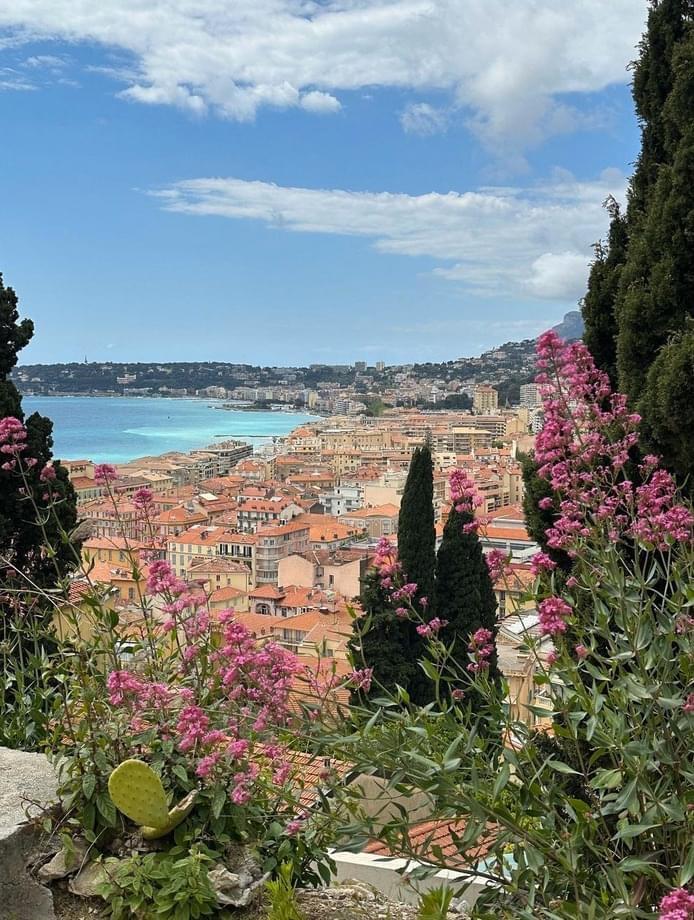
This is Menton

and this is between Nice and Villefranche.

It was another gorgeous day and Huw had to go to Ken’s to cut back the bougainvillea, his favourite hate job. There was another cruise ship in the bay so I’m assuming town was going to be packed. The rade (bay) is getting busier every day.

When he got home late morning we went to Nice for our weekly kebab. It’s getting warmer every day, the summer has arrived alongside all the tourists, there were so many English speakers in the park. We couldn’t find a bench in the shade and it was quite hot in the sunshine – not unbearable yet but getting there. Saying that I love the sunshine and rarely find it unbearable.
On the way home Huw stopped to take a photo of these lovely trees in Place Garibaldi. I looked them up when we got home and found out that they are Persian silk trees.

I found this article about Nice last week when I posted the entries for Villefranche and Beaulieu.
Nice

«Nice Beautiful» is the internationally recognised capital of the Côte d’Azur. Since prehistoric times, people have sought to settle here. Archaeological finds in the Grimaldi Grottoes bear witness to this. They confirm the presence of man in this area during the Paleolithic and Neolithic periods.
In the 14th century, when Avignon became the capital of the West, all of Provence was experiencing a period of flourishing literature and art. But when Provence became definitively French, Nice, bound by close ties to the Dukes of Savoy, took a different path.
Nice was annexed to France in 1793. From here Napoleon began his Italian campaign in 1796. Soon after, in 1814, Nice rejoined the House of Savoy. It was not until 1860 that a wide plebiscite of the population finally made it a French territory.
Since the mid-19th century, the fame of Nice as a centre of tourism is constantly growing. This is thanks in particular to the wealthy English, for whom Nice, with its mild climate and beautiful nature has become a favourite destination.
The light and colours of Nice have inspired many world-famous artists. Among the artists are Engres, Corot, Delacroix, Sutin, Monet, Renoir, Matisse, Picasso, Dufy, Léger, Toulouse-Lautrec, Marc Chagall, Degas, Bonnard, Utrillo. Writers include Balzac, Flaubert, Maupassant, Mérimée, Alexandre Dumas, Montaigne, Baudelaire, Verlaine, Tolstoy, the de Goncourt brothers, Colette, Paul Valéry, Maeterlinck, Maugham. Many people of art not only stayed in Nice, but stayed there forever.
Palais Maeterlinck

The mere presence of such celebrities in the city gave rise to the creation of many museums and galleries, and cemented Nice’s fame as a centre of culture and art. However, it’s not only artists and poets who love Nice. It is appreciated by many politicians, scientists, financiers and aristocrats who come here from all over the world. Nice is not only a good hostess welcoming celebrities, it became the cradle of famous talents. They are the artists Van Loo and Brea, the astronomers Cassini, Maraldi and Lascari, the historian Geoffredo, the Abbe Saint-Paune, J.-M. De Gubernatis — the «not overly popular builder» of Villa Arenes in Simiez, Marc of Nice — preacher in Peru and Mexico, naturalists Baria and Risso, generals Massena, Rusca and Garibaldi.
Each city quarter is distinctive and zealously preserves its original appearance, architectural monuments and ancestral traditions.
The Promenade des Anglais, often symbolises the capital of the Côte d’Azur. The avenue unhurriedly unfolds along the beaches of the Bay of Angels. The palaces which sparkle with windows and splendour are the witnesses of the city’s former luxury: the Palais Negresco, built in 1912 in the «Belle Epoque» style, the Westminster, the Royale. The architectural ensemble is complemented by palm trees, the piercing blue of the sky, and the ever-changing reflections of the sea.
The Negresco

The Westminster

Le Royale.

Attractions
There’s a lot to see in Nice: from the top of the Chateau there’s a rare panorama of the city, the Bay of Angels and the surrounding area. To the east one can see Mount Boron and the port quarter built during the reign of Charles Emmanuel III of Savoy. To the west, the new town is spread out on the slopes of the neighbouring hills, behind which the airport can be seen in the distance against the background of Cap d’Antibes. The place on which the castle is built was in times immemorial a settlement of primitive tribes, then the Acropolis of the Greeks of Marseilles, Castrum under the Romans, and in the Middle Ages, the citadel of the counts of Provence and the kings of Aragon.
Below the Castle, between the Paillon quarter and the Mediterranean coast, the old town, by far the oldest and most picturesque area of Nice, lives a leisurely life. Its narrow, winding streets are built up with houses of different shades of ochre — from almost white to red-brown. The streets lead up, down, and around which the streets turn abruptly. Here the simple people live and you can hear the local melodious accent. Streets Bouchery, Marché, la Lodge, de Woot — they all necessarily lead you to the Place Saint-François to the City Hall, built in the 18th century, to the Cours Saleya Square with its flower market. From early in the morning, the market presents visitors with an abundance of fragrances and colourful flowers. In the evening, the square is alive and well with open-air cafes and restaurants.
The Opera House is also noteworthy.


St. Reparat (Holy Redemption) Cathedral was built in the 17th century by local architect André Guibert. This monument is the jewel in the crown of the old city. The two-tiered facade of the church is in the neoclassical style and the bell tower was completed in the 18th century. The three-nave domed church building is shaped like a Latin cross at the base. The cathedral contains a mitre and the holy relics of St. Bassus, as well as the relics of St. Victor. The old town is connected to the rest of Nice by the Rue Prefecture.

Nice’s main street is named after its former mayor, Jean Medicin. The cathedral of Notre Dame is built in neo-Gothic style and resembles the Cathedral of Notre Dame in its architecture.

The street leads to the Place Massena, remarkable for the beauty and harmony of the architectural ensemble of houses made of ochre stone with a red hue. Every year, the square is the scene of the main show of Nice carnival.




Comments
Post a Comment