Day 3290 (Thursday) 11th June 2026
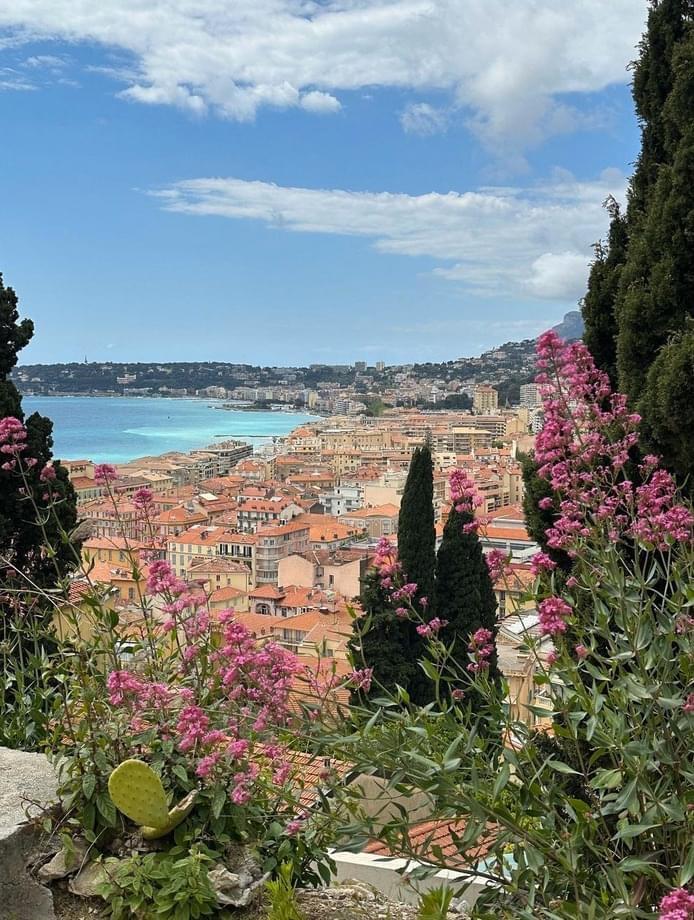
This is Eze

and this is Monaco.

It was another sunny day and the bay was quite busy with private yachts and the tourist boat.

This bougainvillea plant is at the end of our street, while I was taking this photo two men stopped Huw and asked if they could interview him.

They were from the French TV channel two and wanted to know if he lived in Villefranche.

I thought he handled it really well especially considering it was done in French. He’s keeping his fingers crossed that they won’t use it – I hope they do!
VIDEO
I found these small articles about Villefranche and Beaulieu-sur-Mer, they don’t say too much but they are a lovely read.
Villefranche-sur-Mer

Villefranche-sur-Mer stretches along the bay lying between Mont Boron and Saint-Jean Cap-Ferrat. This bay, up to 65 metres deep, is considered to be one of the most beautiful and safest on the Mediterranean. The name Villefranche translates from French as «the free city». It was so named because the Count of Provence, who founded it in the 14th century, established a duty free trade there. During the 16th century, the Duke of Savoy decided to fortify the Cote D’Azur to make it an outpost for barbarians and a port for warships. He ordered the equipping of an inner harbour and the construction of a fortress. Up to the 18th century Villefranche was the principal port of the Sardinian and then Savoyard States, and lost its special importance when the port came to Nice.
Although Villefranche was originally a fishing port, its history is closely linked to the wars at sea. After the Crimean War in 1856 the raid was loaned to the Russian Imperial Navy, and it remained its supply base until World War I. After World War II until France joined NATO in 1962, during the Cold War, it was home to the U.S. 6th Fleet. Now it’s back to being a fishing port and a pleasant, peaceful place.
The old town rises from the raid, where on the waterfront Curb, Italian colourful facades of houses look into the mirror of the sea surface. Walk along Rue du Poilu, (this is our street) the main artery of this city, which is an intricate jumble of narrow streets.
Also, take a look at the Rue Obscure, under the arches of which the population of the city hid during the bombings.
This street is below our place.

Visit the seventeenth-century Church of St. Michael, in Italian Baroque style. It is impossible not to notice the beautiful altar and the marble balusters of the confessional, the eighteenth-century altar decorations, the statue of St. Roch and his dog made of polychrome wood, the fig tree sculpture of Christ lying, said to have been made by convicts, and the magnificent organ made by the Grinda brothers, famous craftsmen from Nice.
Between the beach and the Citadel to the south of the beach, a promenade of brightly coloured Italian-style houses winds along the bay. The ground floors of houses occupied by cafés, bars and inexpensive restaurants. To the northwest, up from the embankment go narrow winding streets, sometimes turning into stairs.
Yacht enthusiasts have long appreciated the charm of the bay of Villefranche-sur-Mer. This is where the most prestigious ships anchor during cruises. Those who simply like to swim and dive will appreciate the transparency of its waters and the comfort of its beaches.
After the interview we took the scooter to Beaulieu and bought a delicious chicken and roast potato sandwich from our favourite kiosk. We took them to the beach to eat. The flowers in Beaulieu are so much better than they are in Villefranche, the park looks gorgeous.

Beaulieu-sur-Mer

Beaulieu-sur-Mer lies between Nice and Monaco, east of Cap Ferrat, just ten kilometres from Nice. Luxurious villas and hotels nestle amid abundant vegetation and palm trees.
The beautiful beaches enjoy mild temperatures all year round, ideal for sunbathing and numerous water sports activities. The family beach, Baie des Fourmis, offers a breathtaking view of Villa Kérylos, and Plage la Petite Afrique features a children's playground and beach volleyball court.
This is the Baie des Fourmis and Villa Kerylos. (Bay des Fourmis means the bay of ants, why call it that?)


Villa Kerylos was built by Emmanuel Pontremoli in the early 20th century at the request of Theodor Reinach. Perched on a cliff overlooking the Mediterranean Sea, it offers visitors an exact replica of a wealthy Greek house from the time of Pericles. Listed as a Historic Monument, the building is packed with frescoes recalling Greek mythology and other artistic marvels.
Rich in architectural and botanical heritage, preserved Mediterranean and exotic flora, Beaulieu-sur-Mer perfectly reflects the spirit of the Côte d'Azur.
The park we sit in is really lovely, a perfect spot for a picnic.




Comments
Post a Comment