Day 3283 (Thursday) 4th June 2026
This was the sky above Nice yesterday

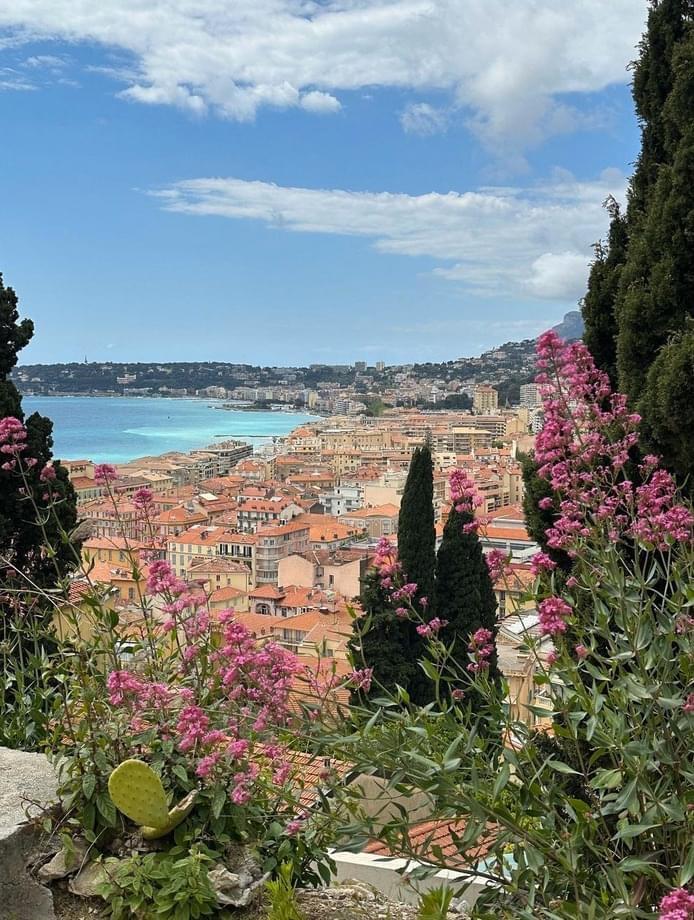
This is between Nice and Villefranche

and this is the port La Darse in Villefranche.

It was a bit cloudy today and there were two cruise ships in the bay. I thought the mayor had stopped two coming in at the same time.

As promised here are the rest of the French expressions…
Ça ne mange pas de pain
“It doesn’t eat bread“, an idiom to express that an action is easy to make. It comes from the 17th century when bread had much bigger importance in French society since it represented the main expense for the food budget. Saying it meant that buying an object for example won’t be deduced from the bread budget meaning it costs nothing.
Avoir du pain sur la planche

“Having bread on the board” is used when a person has some work to, dating back to the time when convicts had to work in exchange for free food, in that case, bread.
Il y a de l’eau dans le gaz
“There is water in the gas“, an idiom that describes a situation with some tension. It is used when there is a clash, an argument in a couple, for example. In the 19th century, for domestic needs, households began to be supplied with gas that contained a fairly high level of water vapour that could cause small explosions and make the flame flicker or even extinguish it.
Vouloir le beurre et l’argent du beurre
Literally, to “want the butter and the butter money“, an idiom that expresses the fact that someone wants everything with only the pros and not the cons. In English, it would be “have your cake and eat it too”. There is a colloquial joke with this expression, the French tend to add at the end “et le cul de la crémière” translated into English gives, “and the milk lady’s arse“.
Compter pour du beurre
“Counting for butter“, another expression with butter commonly used when someone is being ignored, not given importance.

Mettre du beurre dans les épinards
A third French idiom with butter, “to put butter in the spinach“, means that the person manages to improve his living conditions and earn more money.
Comme un coq en pâte

Living “like a rooster on paste” means that you’re having a good life, as a long time ago the rooster was moved with a lot of precautions and was quite comfy.
Avaler des couleuvres
Even though “swallowing a snake” is not a common eating habit, I added it in the “food” list to indicate someone that is a dumb bunny.
French don’t talk only about the 3 Fs “farts”, fashion and food”, they also use wonderful expressions such as “don’t push granny into the nettles” …
Faut pas pousser mamie dans les orties

to say “Don’t push it!” or…
Avoir le rire jaune
“Having the yellow laugh” when you’re forcing yourself to laugh. In religion, Judas was represented as wearing yellow or there is an expression not popular anymore that is “Être peint en jaune”, thus the negative connotation of the colour yellow.
Avoir le cafard
When the French feel down, they don’t feel blue but they “have the cockroach“
Revenons à nos moutons
To go back to the original topic of conversation, French “go back to their sheep” and not to show up to your date, they put a rabbit (poser un lapin), dating back to the end of the 19th century, when lapin (rabbit) meant a refusal of payment.
Chercher midi à quatorze heure
“Look for noon at 2 p.m” is used when someone complicates things unnecessarily and sees difficulties where none exist. There is another super colloquial version with “on va pas tortiller du cul pour chier droit” meaning in English “we won’t wiggle our arse to shit straight”.
Le jeu en vaut la chandelle
“The game is worth the candlelight“. In English, it would be a “simple” expression with “it’s worth the risk“. The origin of this expression dates back to the 16th century when electricity did not yet exist. Card and dice players then had to light the rooms by candlelight during their nightly games, which was very expensive at that time. So it was a luxury that participants were only willing to pay for in high stakes games. By winning, they could eventually pay back the high cost of lighting.
Avoir la langue de bois
You can often hear this expression in the news when a journalist is asking a politician not to speak with a “tongue of wood“. The expression qualifies a speech devoid of reality, which does not answer the problem posed.
Être rond comme une queue de pelle
When you’re drunk as a skunk, you’re round as a shovel handle.

Quand les poules auront des dents
“When the chickens will have teeth” is used to say that something will never ever happen. This French idiomatic expression is from the end of the 18th century. They also have a similar expression, “quand les poules pisseront“, “when the hens pee“.The equivalent in English would be “when pigs fly” which is a funny expression too.

Ne pas casser trois pattes à un canard

You “don’t want to break three legs of a duck” when you’re doing something very easy. As you know, a duck has only two legs, making it impossible to break the three legs of a duck. There is another popular similar French saying that is “ce n’est pas la mer à boire” translated into English “it’s not the sea to drink“.
Il n’y a pas le feu au lac
There is no need to rush, it can wait for later. At first, the expression was simply “there is no fire”. Then, later on, the French add the absurdity “at the lake” to make fun of the Swiss, their neighbourhood. The French tend to think that the Swiss are slow because of their accent. The lake in that case was a reference to lake Geneva (lac Léman) a famous symbol of Switzerland.
Chercher la petite bête
“Looking for the little beast” as when a person has head lice and someone else needs to look for those little insects, that is when a person is trying hard to discover an error or is being picky.
Last but not least, another wonderful expression …
Il fait un froid de canard
“It’s as cold as a duck“, probably coming from the duck hunt, when hunters have to do it in autumn and most of the time they stay for hours in the cold to be able to shoot the poor animal.




Comments
Post a Comment