Day 3282 (Wednesday) 3rd June 2026
A storm was forecasted for yesterday afternoon but it mostly passed us by other than a few drops of rain and a rumble of two of thunder but it hit other areas quite hard and a villa in Saint-Jean Cap-Ferrat was hit and we could see the smoke. Huw found these photos online.


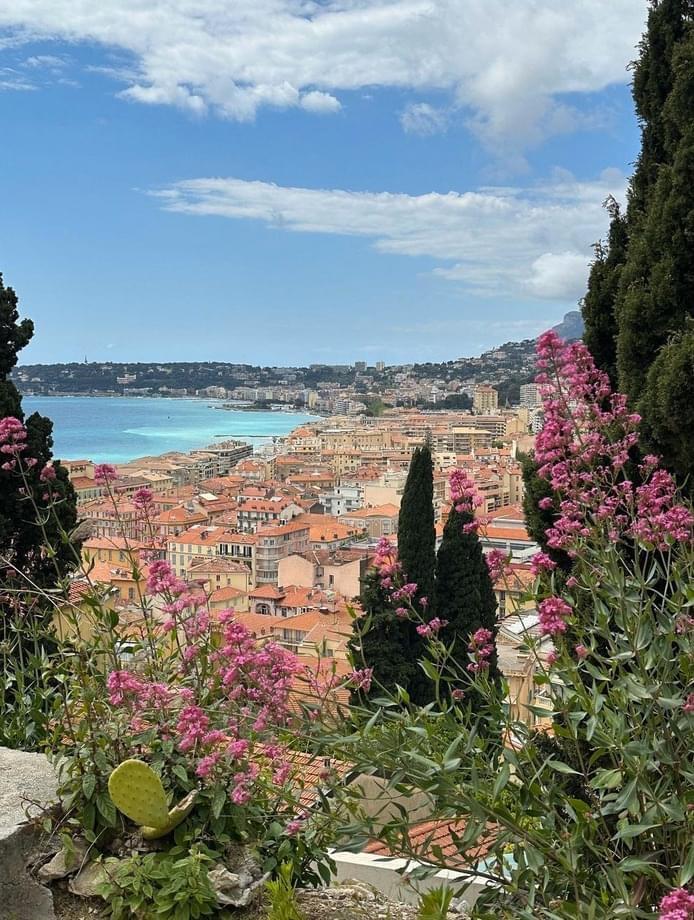
The beach was quite full and it was a beautiful sunny day so we went to Nice for our weekly kebab.

The park was peaceful again after two weeks of rowdy children.

The expensive cruise ship was back in the bay again and the tourist boat was quite crowded.

As promised yesterday, here are some more French expressions…
Being the country of fashion, they have many more expressions related to clothes and fabric, such as…
L’habit ne fait pas le moine
This expression is a common one in romance languages such as Italian and Spanish. It literally translates to “clothes don’t make the monk“, to say that appearances can be deceiving. The English equivalent wouldn’t be so specific: “the suit doesn’t make the man” or “don’t judge a book by its cover”. It is an old proverb of which we find the first traces in the 13th century meaning that wearing religious clothes won’t make you a religious person.
Être dans de beaux draps
“To be in beautiful sheets“, curiously meaning “to be in a bad situation”. This expression dates back to the Middle Ages, when sheets designated clothes. As a form of penance or to show one’s guilt, you had to dress in white, as symbol of purity and innocence, that was supposed to bring out what was “black” in us. In this outfit, one must have felt ashamed and accused of lust. In the past, it was also customary to say: “to be in beautiful white sheets”. Today the qualifier “white” has disappeared, but the meaning of the expression has not changed.
Il pleut des cordes

“It’s raining ropes“- It’s raining a lot. It’s raining cats and dogs.
When you think of France, the second thing that comes to mind after fashion is food and of course the French have thousand expressions related to food. Here are the funniest.
Ne pas être dans son assiette
Literally, “not being on your plate“, meaning to be in a bad mood or not feeling well. In this case, the plate refers to the physical disposition of a thing or a person or its state of mind.
Mettre les pieds dans le plat
Again something to do with the feet; the literal translation is “feet in the dish” and it is used when someone clumsily approached a subject to be avoided without realising it. It is a visual expression, if you put your feet in the dish it would be a silly mistake.
Prendre de la bouteille
Passing on to the bottle, literally “take from the bottle“, when someone starts to age, gain experience, meaning the person became better. It comes obvioulsy from the wine industry, in reference to alcohol that ages in the bottle and gets better.
Aller se faire cuire un œuf
A funny French way to tell to “leave me alone”, as they tell you to “go and cook yourself an egg”. Funny story: the kitchen used to be the wife’s domain. The husband tended to criticise; in such a case, the wife would encourage him to cook an egg, reminding him that he did not know how to cook. The wife therefore obtained peace.
Avoir la patate/la frite
The French are not “in top form“, they have “the potato” or the “French fry”. Similar are “avoir la pêche” and “avoir la banane”. Apparently they use this expression because the one who is in good shape has a good ‘potato’ and that by going through a form like “he has a sacred potato” we arrived at the final diction.
Occupe-toi de tes oignons

The French tell you to “mind your onions ” when they want you “to mind your own business” and when someone does an action with a lot of care, with a lot of attention they do it “aux petits oignons“, with small onions, because when you cook a dish, you might add onions to make it better.
Cracher dans la soupe
Talking about onion soups, this translates literally to “spit in the soup“, as in the past, the soup was considered an essential dish, spitting in it meant refusing something that was perceived as beneficial, thus being ungrateful.
En faire tout un fromage
To “make a big deal out of something ” the French “make a whole cheese about it”, of course.

Starting from not much (milk) we can get something very elaborate, requiring a certain know-how (cheese). Maybe someone who tends to make a big splash from the ground up could be a great master cheesemaker?
Engueuler quelqu’un comme du poisson pourri
The French don’t “give someone a tongue-lashing”, they “yell at them like they’re rotten fish”. To cut someone off they “make a fish tail” (“faire une queue de poisson“) or they “drown the fish” (“noyer le poisson“) to avoid a subject by talking about everything and anything else.
Tremper son biscuit
French men don’t “sleep around”, they “dip their biscuit”.
Ca n’a rien à voir avec la choucroute
The French do not say something “random”, they say something “that has nothing to do with sauerkraut”
Chanter comme une casserole
“Sing like a saucepan“, told to someone that can’t sing or sing flat.

C’est la fin des haricots
When nothing more can be done and it’s game over, “it’s the end of the beans“.

The beans, low-end foods were distributed in boarding schools to schoolchildren as meals, in prisons to prisoners or to people too poor to buy better quality food. When they didn’t even have the money to buy those starches, it really became the end of it all.
Casser du sucre sur le dos
Literally, “breaking sugar on the back“, it means to criticise someone that is not present. In the 19th century, “sucre” (sugar) in slang meant to mistreat. Nowadays the verb “sucrer” means “to get robbed”.
The last of these will be posted tomorrow…




Comments
Post a Comment