Day 3273 (Monday) 25th May 2026
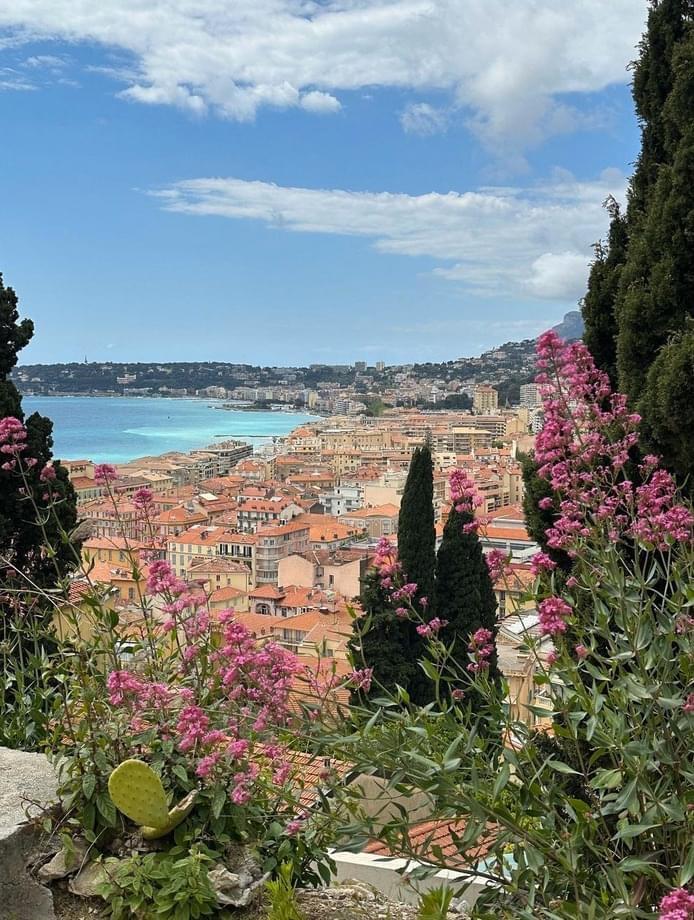
This is Castellar near Saint Agnes

and this is Saint Raphael.

It was a lovely hot sunny day and yet another bank holiday. There was another cruise ship in the bay.

We decided to go for lunch in the square and were delighted to see that the cafés and restaurants have spread their tables and chairs across the square. The last mayor changed the rules asking the restaurants to keep their tables close to the buildings. So it would seem now that the new mayor has allowed them to spread out again and it looks much better.

We stopped in Les Palmiers for lunch where we had a mixed platter of different hams, cheeses, bread, pickles etc and it was very tasty.

Town was super busy with tourists from the cruise ship everywhere and the market was doing a good trade – it’s so good to see our little town getting busier.

As usual on a Monday here’s What’s happening in France this week. The Local France.
Paris Saint-Germain fans will be hoping for a repeat of 2025 on Saturday evening. (Photo by FRANCK FIFE / AFP)

Another public holiday, an important deadline for millions of taxpayers, a major sporting event – and a big day for mothers.
Monday
Public Holiday – The fourth and final jour férié of 2026’s generously holidayed month of May, although Pentecost is a slightly unusual holiday which not everyone gets.
The calendar will be public holiday-free from this date until July 14th – France’s Fête Nationale, which is on a Tuesday.
Thursday
Tax deadline – It’s income tax declaration deadline day for everyone who files their information online and lives in départements numbered 20 to 54.
Slavery – A bill to formally abolish all laws regulating slavery in France will be debated on the floor of the National Assembly, after unanimously passing the committee stage. The bill itself is symbolic, but it's part of measures that France is taking to address its colonial history.
Friday
Fête des Voisins – Neighbour’s day, celebrating the one thing everybody needs, in the hope that good neighbours can become good friends. If you live in an apartment, you may see a reminder in your building … there may even be An Event.
Saturday
Football — The eyes of every Paris Saint-Germain fan will be on the Puskás Aréna in Budapest, as their Ligue 1 heroes face newly crowned Premier League champions Arsenal in the Champions League final. The match kicks off at 6pm, and will be broadcast in France on Canal Plus — and also free to air on M6.
Sunday
Mother’s Day — The French one, anyway, falls as usual on the last Sunday of May. So, if you forgot the UK one, in March, or the US one, earlier this month, here’s a last chance to redeem yourself. You could claim that you now work on the French calendar. Mums’ special day will even be marked celestially this year, by a relatively rare blue moon.
Péter: the French word that can mean farting, breaking, being drunk and more
The Local's French grammar tips. Image: Patick Fore_Meizhi Lang via Unsplash

The French verb péter means either to burst or to fart - but it also appears in dozens of idioms covering everything from boasting to being drunk, via a violent temper.
The verb péter - pronounced as peh-tay - has several definitions.
Originally, it means to burst, break suddenly often accompanied by a sharp noise.
Le verre a pété. - The glass broke. You could also use it to describe a burst tyre on your bicycle.
It also means to fart, it's used quite commonly but considered informal.
Il a pas fait exprès de péter devant la classe. - He didn't mean to fart in front of the class.
The word péter can also be used in the context of someone being completely drunk.
Il a trop bu, il est pété. - He drank too much, he's drunk.
Also can be used to describe success, beating a high score for example.
Il a pété le record. - He beat the high score.
So far so straightforward. However the word is also used in a great many French expressions, sayings and idioms - many of which have no connection to the original meaning of the verb.
All of which can be quite confusing for anyone named Peter.
You may also notice that once the verb is conjugated, the accent type changes - so the verb is péter, while the conjugated verb is il pète.
Se la Péter - This one means to show off, when you say je vais me la péter, the tone of voice is usually self-aware, like saying "I'm going to flex a little bit". But it can also be critical when talking about someone else, il se la pète - he's full of himself/bragging too much.
Péter un cable - Even though this one creates the mental image of an electrical wire exploding, it means that someone is so angry or upset that they are about to 'lose it' or 'freak out'.
There are synonymous expression to this one, also using the verb péter, like péter une durite (break a hose), péter les plombs (blow a fuse) - all these essentially mean to lose one's mind. Si vient pas ce soir, je vais péter un cable - If he doesn't show up tonight, I'm going to lose it.
Péter plus haut que son cul- This one is definitely vulgar, so be careful if you use it. It means to be pretentious, full of yourself or to act as if you are above the people around you.
This expression dates back to the 1600s, and literally translates as 'to fart higher than your arse'. Il est tellement prétentieux, il pète plus haut que son cul. - He's so pretentious, he thinks he's better than everyone else.
Péter le feu - This expression means 'farting fire' - but it really means to be in good form, in good health. It's often used for older people who remain in good health with plenty of energy, but can be used by people of all ages.
J'ai été malade pendant deux semaines mais c'est bon maintenant je pète le feu ! - I was sick for two weeks but I'm fine now, I feel great.
Péter un coup - Now this expression actually refers to farting. It literally translates to "fart a bit" but is used to tell someone to calm down, to relax. Pète un coup, arrête de stresser pour rien. - Calm down, stop stressing for no reason.
Péter les couilles - Another vulgar expression to say that someone is really annoying. It translates as 'ball-breaking', but is really closer to 'ball-ache' - it's very similar to the other French expression casse-couille.
Tu me pètes les couilles avec ta musique - You're really pissing me off with your music.
Péter la gueule à quelqu'un - This one translates to "smash someone's head in". When someone says this, they are insinuating that they are going to beat someone up. Meanwhile, when you say je vais me péter la gueule, it essentially means "I'm going to fall and break my face". Both are considered slang. In fact, gueule which means face in French, is always considered vulgar.
Péter dans la soie - This translates to "fart in silk", but it actually means living in luxury, to be very rich.
Ce mec pète dans la soie, il a un loft à Paris et une villa en Corse. - This guy is so rich, he owns a loft in Paris and a villa in Corisca.




Comments
Post a Comment