Day 3264 (Saturday) 16th May 2026
This is the Old Port of Nice

and this is the pétanque court in Saint Paul de Vence, one of my favourite places in the world.

There was another cruise ship in the bay this morning and when we went out there were loads of people being led around the town by a guide. It wasn’t easy getting past them.


The wind has finally slowed down a bit and we were able to go to Nice for our weekly kebab in the park.

At midday, as always, Huw jumped at the bang of the cannon and I saw it before I heard it.
It’s the white blob in the sky that looks like a cloud.

While we were eating Dee sent me a message and Pat phoned Huw asking us to join them in Bobby’s in the square for a burger so we said we would join them for a beer after lunch.
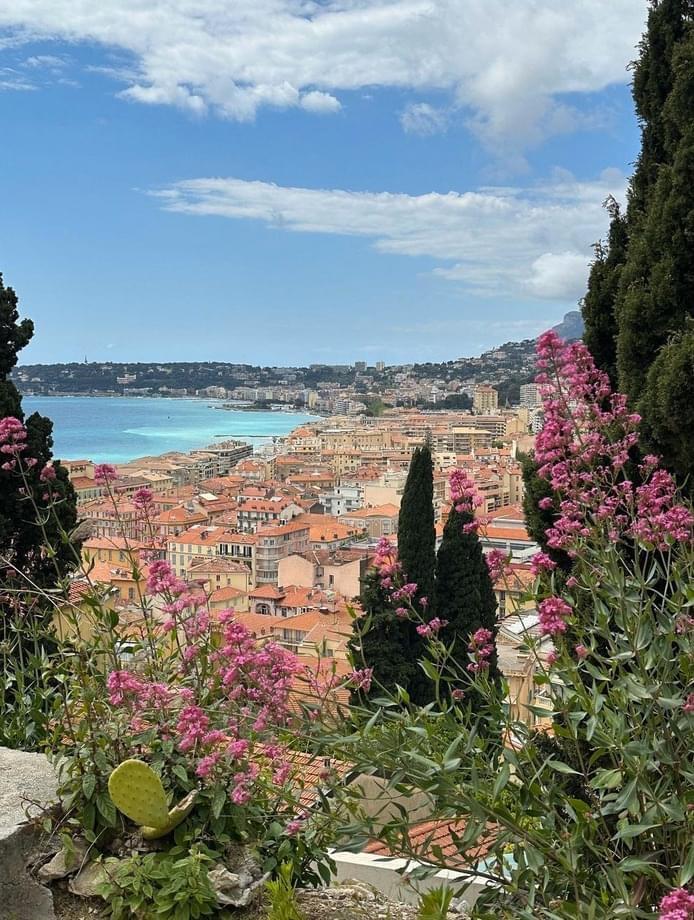
We went up to Fort Alban to enjoy the spectacular views and glorious blue sky.


There were lots of poppies around and Huw tried this arty farty photo of one – it almost works.

This is the entrance to the fort.

After the fort we went into the square and had a beer with Pat and Dee in the lovely sunshine.

Beyond desolé - 7 ways to say 'I'm sorry' in French
All the different ways to say "sorry" in French. (Photo: Melanie Stander/Unsplash)

Foreigners tend to be taught that 'desolé' means sorry in French, but in fact the French language
has a variety of different ways to apologise, ranging from the casual to the phrases used for a more
serious or formal affair.
An Elton John song says, “Sorry seems to be the hardest word” - and that can feel even more true in a
foreign language. Whether you want to sound casual, sincere, or very formal, French has many different
ways to say “sorry” depending on the situation.
Here are some of the most common expressions, from everyday apologies to more formal ones.
Pardon (roughly pronounced pahr-dohn)This is the most common for small things, for example after bumping into someone in the street. You can use it for many different situations but keep in mind that it’s quite casual.Example: Pardon je ne vous avais pas vu! - Sorry I didn't see you there.Not to be confused with the English "pardon?" after you need someone to repeat themselves. Now you
wouldn't be wrong by saying that but your interlocutor might assume you are English and do not speak
French.It's safer to say 'comment?', which is the polite version of 'quoi?', translating to "what?".
Désolé/Désolée (roughly pronounced day-zoh-lay)This way of saying "I'm sorry" is slightly more personal than pardon. It is often used when you are acknowledging responsibility or expressing sympathy. When writing, use désolé for men and désolée for women. Example: Je suis désolé pour le retard. - I’m sorry for being late.You can also use it as a form of politeness in a store, for example, when you need to ask someone
something. Example: Je suis désolée de vous déranger - I am sorry to bother you.It also has a particular nuance as it can be used to express empathy. Just like in English, you would say something like "sorry this is
happening to you". Out of all the different ways to say sorry, je suis désolé is the one that works best when expressing sympathy. Example: Je suis désolé d'apprendre la triste nouvelle. - I'm sorry to hear about the sad news.
Excusez-moi/Excuse-moi (roughly pronounced ex-cue-zay mwah/ex-cuez mwah)
The phrase excusez-moi (formal) and excuse-moi (informal) are used both to apologise and to get someone’s attention. They translate to "excuse me" in English.
You might use it when interrupting someone, passing through a crowd, or politely correcting yourself.
For example, when you’re in a shop, and you want to ask someone a question, you would usually start with excusez-moi.
You might have come across je m'excuse, which is a little tricky as it translates literally to "I'm sorry". Grammatically, the phrase je m’excuse is correct, but it can also be understood in French as "I forgive myself". It's important to be mindful of
the meaning if you want to apologise.
Another formal way of saying "sorry" is je vous prie de m'excuser, which translates in English as “please excuse me”. This phrase is used to apologise in writing and in a
more formal context.
Similarly, you can use je vous présente mes excuses, which translates literally to “I am presenting you with my apologies”.
Finally, another variation would be toutes mes excuses, which means "all my apologies". It is commonly used in professional settings, written communication,
or when addressing someone you don’t know well.
Example: Toutes mes excuses pour l'erreur dans mon dernier mail. N'en tenez pas compte s'il vous plaît. - I apologise for the mistake in my last email. Please disregard it.
Navré/Navrée (roughly pronounced nah-vray)
The phrase je suis navré(e) expresses deeper sorrow or regret, often in more formal or serious contexts. It is frequently used when
delivering bad news.
Example: Je suis navré(e) d’avoir loupé ton spectacle. - I am so sorry I missed your show.
Au temps pour moi (roughly pronounced oh tahn poor mwah)The French expression au temps pour moi means "my mistake" or "I was wrong".This expression has military origins. It was used to instruct a soldier to restart a movement from the
beginning after a mistake. The word temps (which means time) refers to a specific moment in a
sequence, such as in a gymnastic or drill exercise.And today, the expression is used to acknowledge an error and correct yourself.Example: Au temps pour moi, j’ai mal compris ta question. - My fault, I misunderstood your question.
Other formal phrasesSome other formal phrases to say "sorry" include pardonnez-moi/pardonne moi
(roughly pronounced par-don-ay mwah/par-don mwah), which translates to "forgive me". In this instance, the mistake made is probably quite serious, as the
person saying this isn’t sure they will be forgiven by the other person. There's also the phrase c'est une erreur de ma part (roughly pronounced seh-tun eh-rer duh mah par), which translates to "it was a mistake on my part". This one allows you to acknowledge your
wrongdoing clearly and simply. It can be combined with a more explicit apology.
Example: C’était une erreur de ma part. Je vous prie de bien vouloir m’excuser. - This was a mistake on my end. Please accept my apology.




Comments
Post a Comment