Day 3199 (Thursday) 12th March 2026
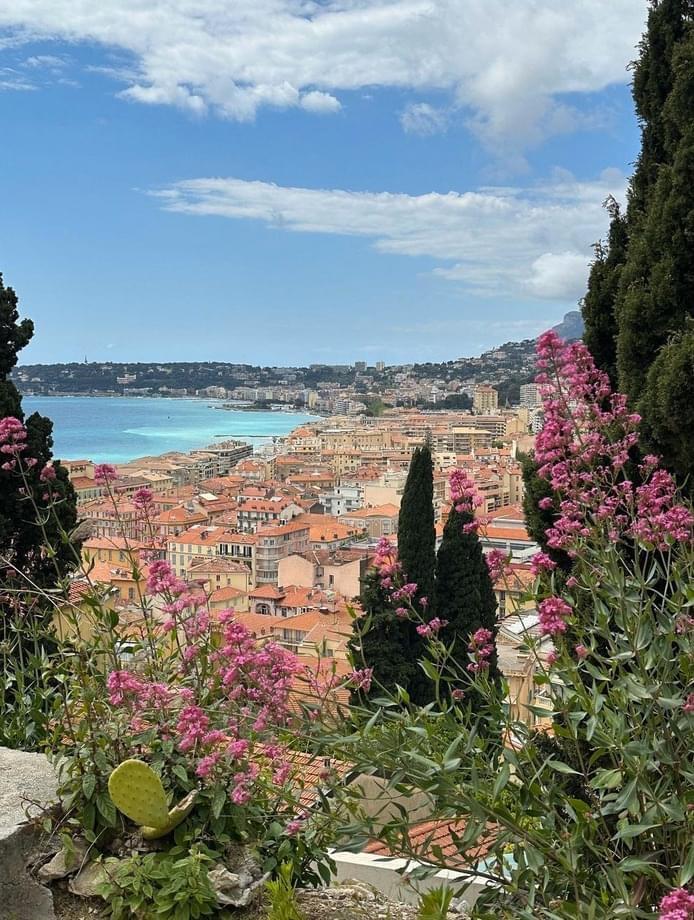
This is Menton

and this is Antibes.

Huw didn’t go to work this morning because it was spitting with a few drops of rain and I had my last French lesson this afternoon. As always we went to eat a kebab in the park before my lesson and it was extra good today, I don’t know why they should taste different but they do. While we were in the park I got an email from the school saying that my final lesson was to be at 4pm util 5.30, I was there ready to have a class at 2pm. We walked over to the school and they said that the email was correct and that they’d sent me the same email last week but I didn’t get it. I pretended that I was working this afternoon and got out of doing the lesson. I have to do two exams, a written one and an oral but I can do this at home. I was very happy to go home.
Here are the last of the unusual facts about France…
Environmental and Social Policies
In 2016, France became the first country to pass a law banning supermarkets from discarding unsold food, requiring them to donate it to charities instead. This initiative has reduced food waste and hunger, inspiring similar laws in other countries.
In the wild in France, there are an estimated 400–500 breeding pairs of golden eagles, 1,100 European grey wolves, and around 80 brown bears in the Pyrénées. (2024).
France is among Europe’s largest hydroelectric power producers, supplying approximately 10-12% of the country’s total electricity generation.
Military and Political Influence
French is the official language of 29 countries and is spoken on every continent. It is the primary language in France, Canada, Switzerland, Belgium, and several African nations.
French is the official language of the United Nations, the European Union and the Olympic Games. It is also a significant diplomatic language.
Established in 1445, the French Army is one of the oldest standing armies in Europe.
General Pierre Cambronne, who led the Imperial Guard at Waterloo in 1815, reportedly responded, “Merde!” to British surrender demands. He invented that famous rude word.
During World War I, the French military developed camouflage techniques, and the word “camouflage” originates from France.
France was a founding member of the European Union, playing a key role in its establishment in 1993.
More Unusual and Strange Facts
Fascinating Laws and Customs
There is a law in France that dictates the exact ingredients and method for making a traditional baguette.
In fashion, the term “haute couture” is legally protected in France, and strict rules govern which fashion houses can use the label.
In France, the “Radio Quota” law requires that at least 40% of the music played on private radio stations be of French expression to support French music and culture.
The final execution by guillotine in France occurred on September 10, 1977. The death penalty was abolished in 1981 during the presidency of François Mitterrand.

By law, French restaurants must provide free tap water upon request.
Quirky Sporting Facts
Pierre de Coubertin is the father of the modern Olympic Games. In 1894, he founded the International Olympic Committee (IOC), and two years later, the first modern Olympic Games were held in Athens.
France played cricket during the 1900 Paris Olympic Games and actually played the final, although it was the only match of the tournament.
Just Fontaine holds the record for the most goals in a single FIFA World Cup, scoring 13 during the 1958 Tournament in Sweden. No player has beaten this record in any tournament since.
Pétanque is so popular that there are over 300,000 registered players in France. In some villages, there are more pétanque clubs than inhabitants.

The Tour de France is a cycling race that covers 3,500 kilometres (2,200 miles) through 21 day-long stages over 23 to 24 days, attracting around 1 billion TV viewers. This year, Tadej Pogačar won his fourth Tour de France title in Paris.

French skier Simon Billy set a world speed skiing record of 255.5 km/h (158.9 mph) in 2023 at Vars.
The first person to ski down Everest was a Frenchman. In 1979, Jean-Marc Boivin set off from the summit of Mount Everest.
French tennis player Nicolas Mahut holds the record for the longest tennis match in history, competing against John Isner for 11 hours and 5 minutes at Wimbledon in 2010.
Fun Eiffel Tower Facts
The Eiffel Tower is just over 1,000 feet tall, has 1,665 steps to the top (unless you take the lift), and is covered in 20,000 light bulbs. It is made of 18,038 puddled iron parts held together by 2,500,000 rivets!
The Eiffel Tower was initially meant to be temporary, with plans to dismantle it after 20 years. Construction began in January 1887 and was completed on March 31, 1889.
The Eiffel Tower’s height can vary by up to 15 centimetres as the iron expands and contracts with temperature changes.
Every day from 1900 to 1914, the “Canon de midi” (noon cannon) would sound from the second floor of the Eiffel Tower, allowing Parisians to set their watches to the correct time.
Erika Eiffel famously “married” the Eiffel Tower in 2007. She has Objectophilia, a condition in which people develop romantic feelings for objects.
In the 1920s, con artist Victor Lustig convinced businessmen that he was selling the Eiffel Tower for scrap metal and pulled off the scam twice.
Fascinating Facts About Paris
Beneath Paris, the Catacombs house the remains of over 6 million people, making it one of the largest underground cemeteries in the world.

The tunnels inside the Catacombs are a labyrinth. In 1793, a man named Philibert Aspairt got lost inside, and his body was found 11 years later.
Hidden beneath the Catacombs is a small underground lake used by workers to navigate tunnels. It’s off-limits to the public.
The Champs-Élysées stretches for about 1.9 kilometres and is 70 metres wide, making it one of the most impressive avenues in Europe.

The shortest street in Paris, Rue des Degrés, is just 5.75 metres long.
The Luxor Obelisk in Place de la Concorde, Paris, is a 3,300-year-old monument gifted to France by Egypt in 1831.

Point Zéro, or Kilometre Zero, is a location in Paris from which all road distances in France are measured, marked by a brass star in the ground.

Driving in Paris can be chaotic, and surprisingly, there isn’t a single stop sign in the entire city. The last road sign was removed in 2016 (16th arrondissement, quai Saint-Exupéry), and has been the only one in the city for numerous years. The capital relies on right-of-way rules.

The Rungis International Market in Paris is one of the world’s largest wholesale food markets. It covers over 234 hectares (578 acres).
The Ménagerie du Jardin des Plantes in Paris, established in 1794, is one of the oldest public zoos in the world.
Final Fun Facts about France
France has more roundabouts than any other country in the world, with over 50,000 of them.
France produces over 10 billion baguettes annually, which amounts to nearly 320 baguettes every second.
A Town Called “Y” - Located in the Somme, the town of Y is the shortest place name in France. Residents are affectionately called “Ypsiloniens.”

The music of My Way, the classic song and jazz standard by Frank Sinatra, was originally written by French singer Claude François and released in France in 1967, under the title “Comme d’Habitude”.
The most popular baby names in 2025 were Gabriel, Raphaël, Léo and Louis for boys, and Louise, Alice, Jade and Emma for girls.




Comments
Post a Comment