Day 3197 (Tuesday) 10th March 2026
This is Saint Joan of Arc church in Nice

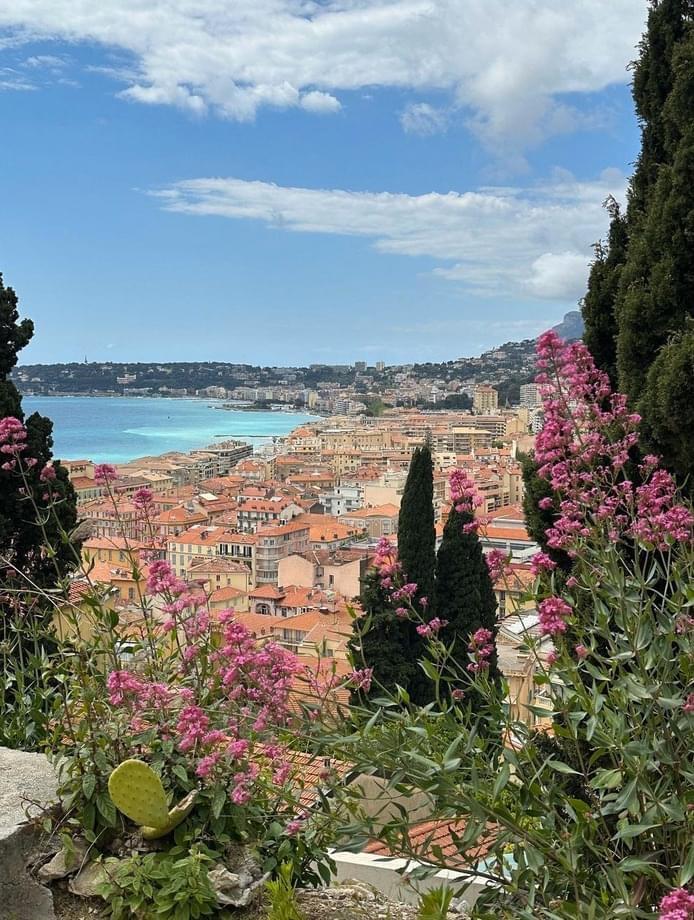
and this is Menton.

I found an interesting website about unusual French facts, it’s quite long so I’ll post it over a few days.
Over 100 Interesting and Unusual French Facts
France is filled with charm and intrigue, from the busy streets of Paris to the scenic Bordeaux vineyards and the bee-filled lavender fields in Provence.

In this article, we invite you to explore over 130 fascinating facts about France, digging into its past, cultural treasures and innovative spirit that have shaped the world as we know it today, with a few random facts for good measure.
Whether you’re a history fan, a foodie or simply curious about the wonders of France, this collection of facts will take you on a journey through time.
Discover the origins of iconic landmarks, the stories behind inventions and the quirky traditions that make France so unique. From the grand Eiffel Tower to the simple baguette, each fact offers a glimpse into the soul of this nation.
So, grab a croissant and a café au lait, and let’s embark on a voyage through the land of love, food, wine, coffee, art and where ‘joie de vivre’ is priceless.
The World’s Leading Tourist Destination
France is the world’s most visited country, with over 100 million visitors in 2024
Tourism plays a significant role in the French economy, contributing €250 billion annually and accounting for approximately 160 billion overnight stays.
France, often called the “Hexagon,” is the largest country in the EU, extending about a thousand kilometres from north to south and east to west.

France’s 13 regions share borders with eight countries: Belgium, Luxembourg, Germany, Switzerland, Italy, Spain, Andorra and Monaco.
France boasts 45 UNESCO World Heritage Sites, including iconic landmarks such as the Eiffel Tower, the Louvre Museum, and the Pont du Gard.

France’s river systems span over 428,900 kilometres, and the longest river in France is the Loire, with 1,006 kilometres.
As of summer 2025, there are 182 certified “Plus Beaux Villages de France” spread across 72 French departments.
France attracts over 55 million skiers annually, making it one of the top three ski destinations in the world, competing with Austria and the USA.
Historical and Cultural Influence
France’s Role in World History
After the Norman Conquest of 1066, French became England’s official language and was used in the courts, in law, and by the aristocracy until the late 1300s.
Construction of the Notre Dame de Paris Cathedral began in 1163 and was completed in 1345, nearly two centuries later.

The Pope lived in France during the Avignon Papacy (1309–1377), when the papal court was moved from Rome to Avignon.
Napoleon Bonaparte was born on August 15, 1769, in Corsica. His family was of Italian heritage, and his birth name was Napoleone di Buonaparte.
The youngest French king was Louis XIV, who ascended to the throne in 1643 at the age of five. He passed away in 1715, after a 72-year reign.
The shortest reign of a French King lasted only 20 minutes; Louis XIX ruled for that brief period in 1830.
The French Revolution inspired democratic ideals globally, and the Declaration of the Rights of Man and Citizen (1789) continues to shape contemporary democratic principles.
French Fashion and Culture
The first fashion show originated in Paris during the early 20th century, laying the foundation for the modern fashion industry.
Herminie Cadolle was a French fashion designer credited with creating the first modern bra-like garment in the late 19th century.

The town of Oloron-Sainte-Marie, in the Pyrenees, is home to Laulhère, France’s oldest béret manufacturer, still making millions of traditional handcrafted bérets.
Nîmes, the birthplace of denim in the 17th century, is home to Atelier Tuffery, one of France’s oldest jean manufacturers, still making handcrafted jeans today.
Louis Cartier introduced the wristwatch in 1904, providing a stylish and convenient way to tell time.
Maurice Levy invented the retractable lipstick tube in 1915, making lipstick more portable and convenient.
The town of Grasse in southern France is considered the world’s perfume capital. It produces over two-thirds of France’s natural aromas.

The Limoux carnival is the longest in the world. These traditional celebrations take place in February and March, and last 11 weeks.

Literary and Artistic Contributions
France holds the record for the most Nobel Prize winners in Literature. Since the award was first given in 1901, France has won 16 Nobel Prizes, more than any other country in the world.
Leonardo da Vinci spent his final years in France, invited by King Francis I in 1516. The king gave him a residence in the Loire Valley, where he pursued his artistic and scientific pursuits.
The Statue of Liberty, designed by Frédéric Auguste Bartholdi and engineered by Gustave Eiffel, was a gift from France to the USA in 1886.

The first public cinema screening took place in Paris on December 28th, 1895, by the Lumière brothers.
The Montgolfier brothers launched the first manned flight with a hot-air balloon in Paris on November 21, 1783. The flight lasted 25 minutes and covered approximately 9 kilometres.
Scientific and Technological Advancements
Contributions to Science and Medicine
Marie Curie was the first woman to win a Nobel Prize. In 1903, she received the Nobel Prize in Physics, which she shared with her husband and Henri Becquerel. She died aged 66 from leukaemia, due to prolonged exposure to radium and polonium. To this day, her notes remain too dangerous to be used freely.
French physician Jean-Baptiste Denis performed the first recorded human blood transfusion in 1667.
The stethoscope, invented by René-Théophile-Hyacinthe Laennec in 1819, revolutionised medical examinations by amplifying heart sounds.
Louis Pasteur’s pasteurisation process (1865) made food safer by eliminating harmful bacteria, significantly improving public health.
The BCG vaccine, developed by Albert Calmette and Camille Guérin in 1921, has saved countless lives by preventing tuberculosis.
Charles Frédéric Gerhardt discovered aspirin in 1853, providing widespread relief from pain and inflammation.
Etienne-Emile Baulieu was a biochemist who discovered the abortion pill RU-486 (mifepristone) in 1980, transforming reproductive health.
More fun facts tomorrow…




Comments
Post a Comment