Day 3192 (Thursday) 5th March 2026
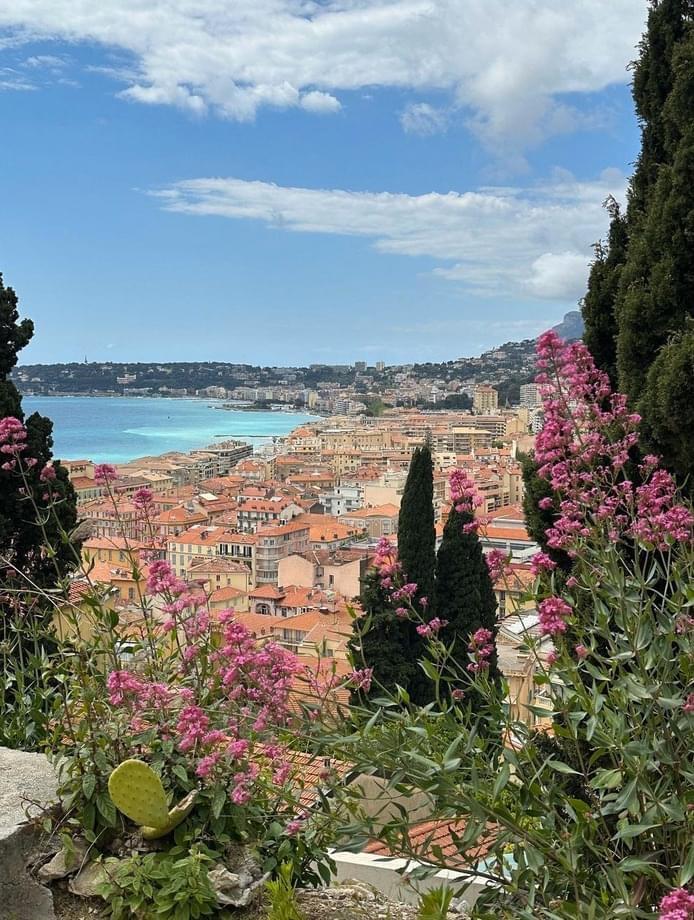
This is Antibes

and this is Nice.

We went into Nice to have our weekly kebab in the park. It was a bit overcast so there are no lovely photos of blue sky today.

Huw went home and I reluctantly went to my French class, I lasted a bit longer this week and Irina (my teacher) told me that next week is my last week – I must admit it felt good.
On the way home I saw that they are dismantling the big wheel in Place Massena.

Here is the rest of the article on French stereotypes…
We dress with a certain "je ne sais quoi"
Whether it's Coco Chanel haute couture with high heels or a marinière striped shirt, we are considered stylish, elegant and well put together. And the French wear berets, of course.
Not that true, I'm afraid. We still dress up more than American cultures and anglophone countries when we go out, but the casual look is making rapid inroads. We may know how to tie a scarf but we also wear Converses to brave the cobblestones.
We are very formal
Oh, how true. Our polite formulas probably haven't changed much since the Ancien Regime, and the subtleties are such that no one raised outside France can make any sense of them. I read somewhere – and do agree – that while the English are encouraged to write the way they speak, we French are encouraged to speak the way we write.
Our everyday lives are governed by formality, from the way we greet one another (Monsieur, Madame) to how we speak to one another (the more formal 'vous' as opposed to the casual 'tu', which is perfectly acceptable among young people and close friends), to how we sign our letters. Even a short note ends with a swirl of a formula more suitable to Versailles than to modern-day Paris, along these lines: Kindly allow me, dear Sir/Madam, to present you with my most excellent wishes. Yes, it's a lot easier to sign off 'Sincerely Yours'.
That said, these strictures are all relaxed in the face of foreign visitors. You can't be expected to know every detail, can you...
We eat really strange foods
This is one of those French food stereotypes which is absolutely true.
But not everything we eat is odd and we do love good food: our culinary history is a long one and there is much to tell about our preferred dishes and our table manners.
Our specialties are rich and varied: bouillabaisse (fish soup) in Marseille, fondue in the Alps, choucroute (sauerkraut) in Alsace, foie gras in the southwest, oysters from Aquitaine or Brittany, Auvergne cheeses, croissants in Paris, Quiche Lorraine, cider from Normandy, escargots from Burgundy (yes, French snails), frog legs in my own region in eastern France...


This is a tiny selection from the diversity of French regional foods, and each region, department, city or even village has its own specialty.
We also have universal foodstuffs, like French wine and beer and baguettes, and foods that have arrived with immigration, like pizza or kebabs. As you can see, we're are not as homogenous as you might think.
It's not just what we eat – it's also how we eat.
We drink a lot of wine
We do, more than any other country - the average French person drinks about 44.2 litres of wine a year. If you figure there are about 7 glasses in a litre, the average works out to 309 glasses of wine a year. That's less than one glass per day...
Let's compare: Australia drinks about half the amount we do, some 23.7 litres per person. The UK weights in at 20.2, New Zealand at 17, Canada at 12.5 and the USA at an extremely modest 10.4 litres per year, about a quarter of France's consumption.
We are strong on manners
While some rules of eating are etched in stone (and have been since Louis XIV inaugurated Versailles), other rules are simply to be obeyed because - that's what Maman said we should do. Table manners are taken seriously here, and a faux pas at the table can set you back, socially of course, but even professionally, if you happen to be lunching with a prospective employer.
It's so easy to get it wrong... picking up certain foods with your hands (some are acceptable, like frogs' legs, and others are not, like chicken thighs), or eating noisily with your mouth open (don't expect to be invited back), or wearing your napkin around your neck.
And it's not just about eating.
We can be obsessed with manners but strangely so, considering we can also be unspeakably rude people. Perhaps not rude, but a little off-putting and standoffish enough to appear so.
Manners in general are considered important, at the table and beyond.
For example, if you walk into a shop or elevator where there are people, you must say Bonjour. It is simply the done thing. If you forget that and walk into your local boulangerie without acknowledging anyone, do expect to be ignored, or served most perfunctorily. You might even get cut off as you order with a pointed "Bonjour" from the saleslady. If not, the stony stares from fellow shoppers should alert you that some is very wrong...
Don't forget to say Bonjour when you go buy your daily bread!
Here's another example: speaking loudly. If I can clearly hear your conversation, you're being loud (we would say rude, but never to your face.)
Or if you call me by my first name before we know each other better (unless you're a millennial, in which case these rules go out the window because young people everywhere are less formal), or if you ask me a personal question, like how much I make (none of your business) or how much my house cost (that too).
France can be an obstacle course of manners but in the end, polite or not, we will forgive you because you are, after all, a foreigner in our land and we must be polite.
We are family focused
While in many parts of the world shops are open on Sundays, in France this is a rarity, confined to the most touristed parts of Paris and the rest of the country. Otherwise, Sundays are sacred, not in a religious way but because it is when the family sits down to a Sunday lunch. Each time the issue of Sunday openings is raised by some hapless politician, the topic is slapped down by anyone desperate to protect their 'family time'.
This also speaks to quality of life. In some cultures, earning double overtime on Sundays is enough to encourage a healthy contingent of workers to set aside their weekends in return for the extra cash. Not so in France. While we will absolutely go on strike for more money, don't touch our Sundays. That is when we rest from the week. For the same reason, holidays too are venerated, not the ridiculous two or three weeks that some countries award, but a full six weeks of togetherness, where an extended family packs off together to their country house or rented holiday home or campground for a month.
We love our small shops
It's not that we hate shopping malls — in fact they're becoming ever more popular, and by their presence endangering our small-town and village shops.
We like to shop in our small-town businesses when we can, chatting with shopkeepers and getting that personal attention we cannot expect in large chain stores. (Just don't forget that essential Bonjour!)
For small purchases we still tend to pay cash, although most of us now have debit cards we can swipe for small purchases or use with a code for something larger. You may also be surprised at how many French still use checkbooks.
While mores are changing because more women work, traditionally, French women used to go to the shop every day to buy fresh produce and, of course, the proverbial baguette (except on weekends, when the men buy the baguette as an excuse to stop by the café for a quick drink with les potes, the buddies.)
Having a job outside the home means having less time to shop, and these days shopping is often confined to a Saturday supermarket excursion.
Weekend markets, however, still allow us to feel connected to our roots and somehow we trust the fresh fish and cheese wheels and just-picked fruit from the market more than we do the cellophane-wrapped products on supermarket shelves.
On weekends, we love to stroll through our brocantes, or flea markets, of which we have thousands.
France has plenty of wonderful department stores, like the Galeries Lafayette, which you'll find in many large cities.
But we still love our shops…
I finished knitting the coat for little Ruby (Pat and Dee’s dog) and Huw put it on Badger last night. He hated it but he looked so cute.




Comments
Post a Comment