Day 3179 (Friday) 20th February 2026
It was lovely and sunny again today so we decided to take the scooter to Menton to see the Fete du Citron. The theme this year is the ‘Wonders of Life.’

But before the photo fest here we have some history of Menton…
History of Menton
City of Menton - Archives Department
A charming legend is attached to the origin of the city and its symbol, the lemon: Eve, expelled from the Garden of Eden with Adam, took a golden fruit with her. Adam, fearing divine wrath, asked her to throw it away. After crossing mountains, valleys, and plains, they sighted the Bay of Garavan. The gulf, the mild climate, the lush vegetation... everything reminded Eve of the sweetness of Eden. She buried the lemon there. In this place, a little paradise was born: Menton.
Origins
More prosaically, the origins of the name Menton and the first inhabitants who populated the site are not well known. Was it a city of Roman origin built in memory of Emperor Otto? Or a hideout built by pirates from the island of Lampedusa, between Malta and the African coast? Was the town placed under the rule of Otto, Count of Ventimiglia, during the Middle Ages? What is more certain is that at the end of the 11th century, a small fortified town called Podium Pinum or Puypin, owned by the Counts of Ventimiglia, stood atop a hill, the very one where the Monastery of the Annunciation now stands. A new settlement then developed closer to the sea, along the old Roman road coming from Italy. It grew up around the castle and the Basilica of Saint Michael the Archangel: the old Menton of today is the original heart of the town.
Genoa, Monaco, France
The Lordship of Menton appears in the 12th century, it then belonged to the Genoese Vento family. In 1290, Manuel Vento, son of William, granted the town its communal statutes (700 years later, in 1990, Menton celebrated this event with a grand medieval festival). In 1346, Menton became the property of Charles Grimaldi, Lord of Monaco. From then on, its history became intertwined with that of the Principality. Honoré II, one of the Princes of Monaco, had his palace on Rue Longue. He had the Bastion built in 1619 to protect the town. In the 18th century, the town had 4,000 inhabitants, who lived mainly from fishing and agriculture. In 1848, Menton seceded and proclaimed itself a free city under Sardinian protection. It chose to join France in 1860, and Charles III of Monaco relinquished his rights to the town to Emperor Napoleon III. Menton was then attached to the Alpes-Maritimes department.
A trendy seaside resort
From 1880 onwards, Menton benefited from the tourist development of the French Riviera. The English doctor Henry Bennett established its excellent reputation. It became a popular health resort for English tourists and the Russian aristocracy. Luxury hotels and villas sprang up. Illustrious guests came to vacation there: crowned heads – Empress Eugénie, King Albert I of Belgium, Alexander I of Russia, Queen Victoria of England – as well as famous artists: the sculptor Auguste Rodin, the composers Franz Liszt and Charles Gounod, the writer Blasco Ibáñez… It is to the geographer Élisée Reclus that Menton owes its nickname "Pearl of France"...
During the First World War, hotels and luxury hotels were converted into hospitals. During World War II, Menton was annexed first by the Italians and then by the Germans.
After being partially devastated, its reconstruction was completed in the 1960s, when Menton regained its status as a tourist resort.
The Quai Bonaparte

Napoleon, who was then only General Bonaparte, stayed at number 5 Rue de Bréa in April 1796 while commanding the Army of Italy. A plaque commemorates this: "Napoleon Italian petens, an 1796, estivit et quievit" (Napoleon, on his way to Italy, stopped at this house and rested). It was from Menton that he dated his order of the day of 14 Germinal, Year IV (April 4, 1796). He had already stayed there in 1794, when, as a brigadier general, he was in charge of inspecting the coast.
Before 1808, the houses of the Old Town reached directly to the rocks by the sea. All traffic to Italy passed through Rue Longue.
For strategic and economic reasons, it was decided to build a road between the sea and the rocks. On June 7, 1808, the town council allocated 7,500 francs for the project. In 1811, fishing boats were requisitioned to transport "stones of all kinds," and by October of the same year, 110 workers were employed on the construction site. In April 1812, Mayor Jérôme de Monléon requested funding for the road.
A few years later, it was "operational." Between 1811 and 1815, Menton's fishing vessels were requisitioned to transport materials, to the detriment of their own activities and equipment.
It wasn't until the 1890s that the West Bay and East Bay were directly connected by the construction of the large curve bypassing the lower part of the town. Over the years, this "narrow road" became inadequate. The decision was then made to widen the Quai Bonaparte.
In 1901/02, the quay was widened by the construction of vaults (as in Cannes on the Quai St Pierre). It then rested on 16 arches; since 1963, seven new arches have completed the structure.

Back to the citrus festival…


The floors are as beautiful as the structures.

This tiger was wonderful and it moves and roars.


This is a whale


Menton Lemon Festival: Facts and Figures
20 days-long Festival
240,000 spectators each year
1928: 1st exhibition of flowers and citrus fruit in the gardens of the Riviera Palace
1934: 1st edition in 1934 of the Fête du Citron
1st edition of the carnival-style event in 1935
Each year has had its theme since 1955
Over 750,000 elastic bands for attaching the citrus fruit
140 tonnes of citrus fruit for the gardens and floats
8 km of synthetic garlands
10 floats covered with citrus fruit parade the Promenade du Soleil
13 decorated displays in the gardens


I don't know what this woman has to do with the "Wonders of Life.'


Lemon trees for sale

We got back on the scooter and headed towards the beach in search of a sandwich. The stands to watch the parades are huge.

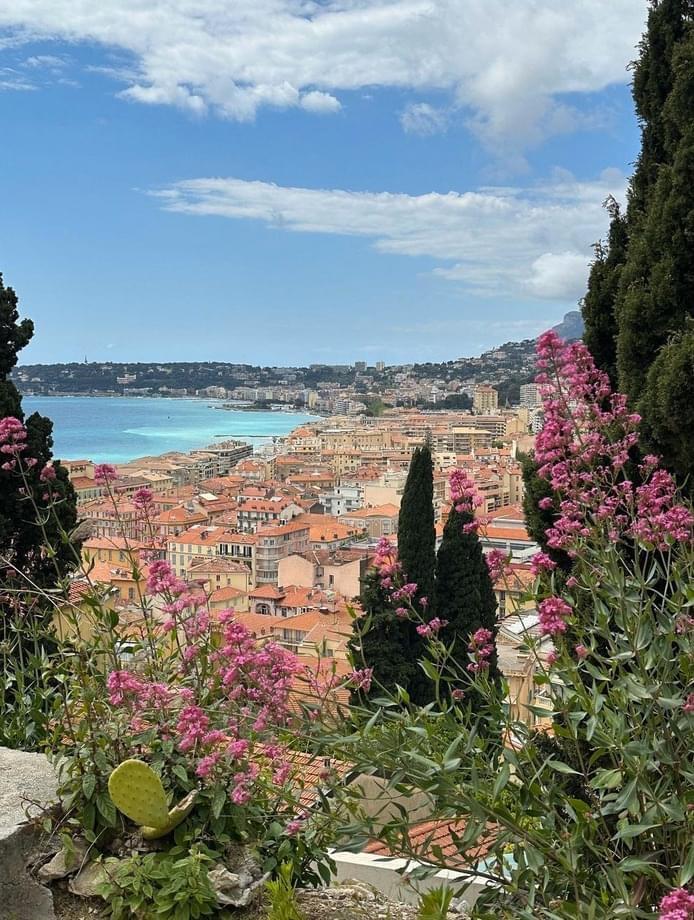
This is the old town

This little boat on a roundabout has the word Menton on it but it’s spelt Mentan, I wonder if that’s Italian.

We found a boulangerie and bought an incredibly boring sandwich and ate it near the beach.




Comments
Post a Comment