Day 3177 (Wednesday) 18th February 2026
This is Eze

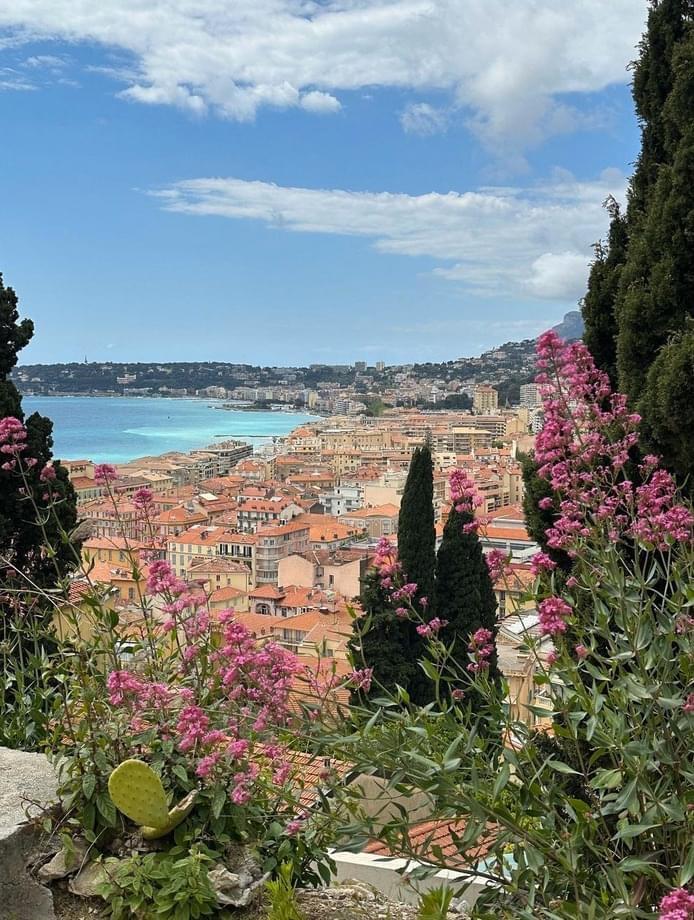
and this is Menton.

Pat put this photo of the Battle of the Flowers on WhatsApp yesterday, apparently it’s a real photo that has been enhanced with an iPhone.

This was the sunrise this morning.


I had to get up super early again today to do a Zoom lesson with Bertran but at least it’s getting lighter at 7am.
After the lesson Huw and I went down to the Old Port of Nice to watch the parade. The sky was a wonderful colour but there is still a nip in the air.

There was a Battle of the Flowers in Nice this afternoon so we went to have a look.

FLOWER PARADEis made up of around fifteen allegorical floats decorated with fresced.
The romantic side of Carnival
Every year, costumed actresses parade on floats decorated with flowers and shower the public with them. The flower parade represents a unique spectacle which has made the reputation of the Côte d’Azur.
To discover the origin of this festival, you have to go back in time to 1876 to see the first Flower Parade appear on the Promenade des Anglais created by Andriot Saëtone. At the beginning, they were simply flower exchanges organised to entertain tourists, but very quickly the Flower Battles were held to honour the work of local producers. The new event became established, in France and internationally, as the social highlight of the Belle Époque and the interwar period.
In 1966: the first televised broadcast of a Flower Battle.
Since 2005, the theme of the Flower Parades has matched that of the carnival parades.
Today, this event highlights the great floral diversity that makes up the region, since 80% of the flowers used are produced locally.

Florists take over the Halle Spada area for 72 hours before each event and pick fresh flowers: in total, 250,000 stems of flowers and 21 tonnes of mimosas are distributed to the public.
The unique costumes are created in a temporary workshop dedicated to Carnival by costume designers from the entertainment world who juggle with original fabrics and materials, giving free rein to their imagination.
Today, the flower parade is made up of around fifteen allegorical floats decorated with fresh flowers, surrounded and preceded by street performers (jugglers, stilt walkers, etc.).

3,000 fresh flowers
Since 2005, the floats have followed the theme of the carnival processions. Each of them is decked out with 3,000 fresh flowers.
100,000 stems
A total of 100,000 stems of flowers (gladioli, gerberas, daisies, carnations, roses, lilies…) are thrown to the public.
20 tons of mimosas are distributed to the public.

The float entertainers
Each float has lots of people on board who throw 80,000 to 100,000 flowers to an enthusiastic public : gladioli, tokyos, mimosas, gerberas, daisies, roses, carnations … and all the remaining flowers are offered to the public at the end of the parade.
Each year, a casting session takes place with young motivated candidates aged 18 to 30, with talents as dancers or in the circus arts.
The future queen of the Flower Parade is among the 18 young girls selected during the casting.

A few years ago we happened to be riding past the junction where the floats on the way to the parade turn and we stopped to admire the them. Knowing what time this occurred we went a café to watch it last year and so we did it again today. It’s wonderful to be able to watch it without all the crowds. It was a bit later than usual so Huw went down to the end of the street to see where they were and then it all started so we were on different sides of the road taking very similar photos.




Comments
Post a Comment