Day 3149 (Wednesday) 21st January 2026
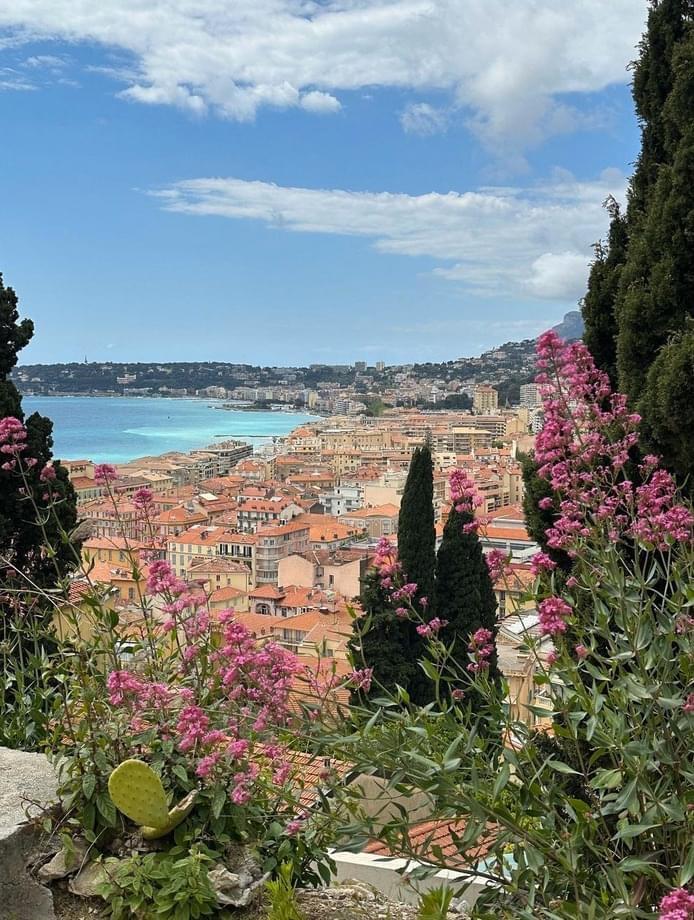
This is Cagnes-sur-Mer

and this is Villa Reve d’Azur in Villefranche.

Huw very kindly took me into Nice again this morning to work with Pauline and the sunlight was beautiful today but it was super-cold on the scooter. Huw went to work on the villa.

It was Pauline’s last day with me today, she is going to Dubai on Friday to work. She has 3 4-hour classes with me on Monday to Wednesday and 2 4-hours classes with another teacher on Thursday and Friday, surprisingly she is having a class this Friday from 9 to 1 and then leaves for Dubai at 6pm – madness.
She brought us some breakfast this morning to say thank you for everything and we had Madeleines and Pain au chocolat. She is from Toulouse and so she calls them chocolatine and she told me the story of the different words, which I already knew but didn’t want to spoil her story.
Pain au chocolat

(French: [pɛ̃ o ʃɔkɔla] , lit. 'chocolate bread'), also known as chocolatine (French: [ʃɔkɔlatin]) in the south-west part of France and in French speaking parts of Canada, couque au chocolat in Belgium, or chocolate croissant in the English-speaking countries, is a type of Viennoiserie consisting of a cuboid-shaped piece of yeast-leavened laminated dough, similar in texture to a puff pastry, with one or two pieces of dark chocolate in the centre. The chocolate usually has a slight bite to the texture.
Pain au chocolat is made of the same layered doughs as a croissant. Often sold still hot or warm from the oven, they are commonly sold alongside croissants in French bakeries and supermarkets.
I had never had a Madeleine before and it was surprisingly good, this is their story.
Madeleine (cake)

The madeleine (English: /ˈmædəlɪn/ MAD-əl-in, /ˈmædəleɪn/ MAD-əl-ayn or /ˌmædəlˈeɪn/ MAD-əl-AYN, French: [madlɛn]) is a traditional small cake from Commercy and Liverdun, two communes of the Lorraine region in northeastern France.
Madeleines are very small sponge cakes with a distinctive shell-like shape acquired from being baked in pans with shell-shaped depressions.
A génoise sponge cake batter is used. The flavour is similar to, but somewhat lighter than, sponge cake. Traditional recipes include very finely ground nuts, usually almonds. A variation uses lemon zest for a pronounced lemony taste.
Invention
Madeleine pan

Legend
Several legends are attached to the "invention" of the madeleines. They have tended to centre on a female character named Madeleine who is said to have been in the service of an important character in the history of Lorraine – although there is no consensus over the last name of the cook nor the identity of the famous character. Some believe that the illustrious patron was 17th-century cardinal and rebel Paul de Gondi, who owned a castle in Commercy. Others think that the inventor was named Madeleine Paulmier, who is said to have been a cook in the 18th century for Stanislaus I, duke of Lorraine and exiled King of Poland. The story goes that, in 1755, Louis XV, son-in-law of the duke, charmed by the little cakes prepared by Madeleine Paulmier, named them after her, while his wife, Maria Leszczyńska, introduced them soon afterward to the court in Versailles. Much beloved by the royal family, they quickly conquered the rest of France. Yet other stories have linked the cake with the pilgrimage to Compostela, in Spain: a pilgrim named Madeleine is said to have brought the recipe from France to Compostela, or a cook named Madeleine is said to have offered little cakes in the shape of a shell to the pilgrims passing through Lorraine.
Other stories do not give the cake a Lorraine origin and lay its invention at the feet of pastry chef Jean Avice, who worked in the kitchens of Prince Talleyrand. Avice is said to have invented the madeleine in the 19th century by baking little cakes in moulds normally reserved for aspic.
First recipes
The term madeleine, used to describe a small cake, seems to appear for the first time in France in the middle of the 18th century. In 1758, a French retainer of Lord Southwell, an Irish Jacobite refugee in France, was said to prepare "cakes à la Madeleine and other small desserts".
Cakes à la Madeleine
On a pound of flour, you need a pound of butter, eight egg whites and yolks, three fourths of a pound of fine sugar, a half glass of water, a little grated lime, or preserved lemon rind minced very finely, orange blossom praliné; knead the whole together, and make little cakes, that you will serve iced with sugar.
Menon, Les soupers de la Cour ou L'art de travailler toutes sortes d'aliments, p.282 (1755).
The appearance of the madeleine is indicative of the increasing use of metal moulds in European baking in the 18th century (see also Canelés), but the commercial success of the madeleine dates back to the early years of the 19th century. Several mentions of the madeleine are made by culinary writers during the Napoleonic era, in particular in the recipe books of Antonin Carême and by famous gastronomer Grimod de la Reynière.
In Commercy, the production at a large scale of madeleines is said to have begun in the 1760s. In addition to being sold at the rail station, thus accelerating their spread through the country, it is likely that the cakes were exported to Paris along with the marmalade from Bar-le-duc and the croquantes from Rheims. By the end of the 19th century, the madeleine is considered a staple of the diet of the French bourgeoisie.




Comments
Post a Comment