Day 1995 (Thursday) 24th November 2022
It was another gorgeous morning 28 degrees in direct sunlight and I spent a few happy hours sunbathing on the balcony.

Our bougainvillea is looking good – I know it’s not much but it’s the best we’ve seen since we bought it four years ago. I am also happy that it’s red – I bought a red plant but the following year it went pink – now it’s red again.

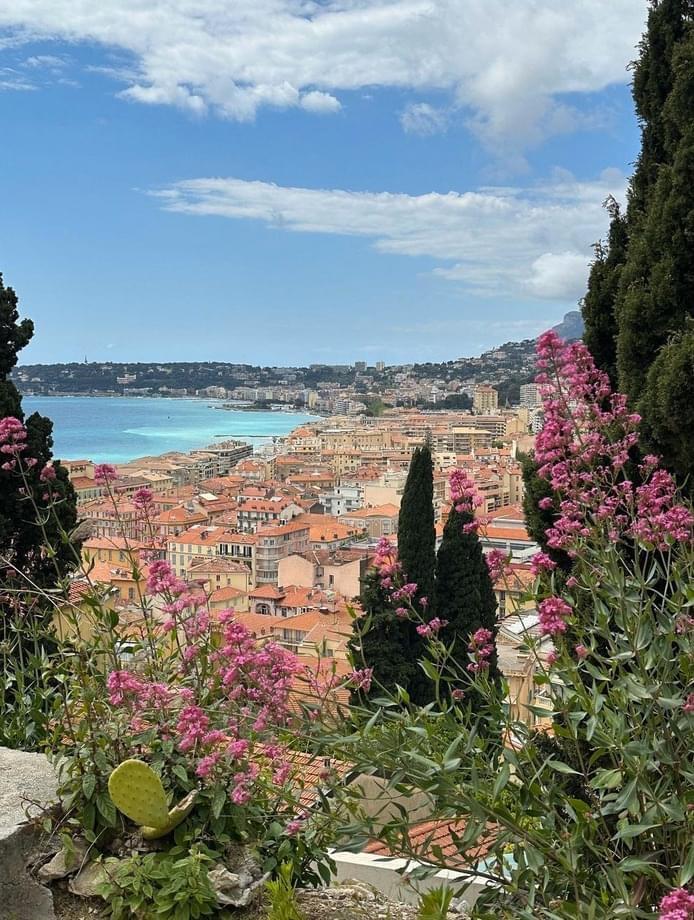
Huw found this beautiful photo of Saint-Jean Cap-Ferrat on Facebook this morning.

What are some mannerisms that are unique to French people?
La bise, of course!
We greet people in social occasions by giving them a series of light kisses on the cheeks, changing cheeks for each kiss. Well, most of the time, we just barely touch each other’s cheeks while giving a smooch to the volume of air sitting right next to the person’s ear.
Weird, right?
Now, this is where things get complicated.
We don’t engage in bises with everyone
Usually, up until the age of ten to fourteen, you give bises to everyone you meet in social circumstances. Conversely, as an adult, you’ll give bises to all children under that age.
During adolescence, if you are a boy, you progressively replace the bise with handhsakes with men.
So, adult men shakes hands with other men (except maybe the men in their family, wich get bises), and give bises to women. Women give bises to everyone.
Remember, this is only in social occasions. I mean parties, social meals, trips out, family meetings. You’ll never engage in bises with your doctor, or anyone else you meet in a customer/service provider relationship, for instance.
What about the workplace, then? Aha, great question. It depends enormously on the company. In some places, you just greet your coworkers with a hello every morning. In some others, it’s a handshake or bise depending on genders. And finally, in some others it’s a handshake for everyone. I would say that the bise is still pretty rare in the workplace.
Funnily enough, you might greet the same person differently depending on the occasion. Every single time I see my parents, I give them a bise. But back in high school, I would say hello to my female friends every day and give them a bise when we met outside of school. Nowadays, in college, I give a bise to my female good friends whenever I see them, be it at school or outside. Except for my roommates, which I greet every morning with a hello, and mostly hug before and after not seeing them for a while.
Still hanging in there?
The number of kisses you do for a bise varies depending on regions
I give you, the Bise Map! The small chunk to the left is not an island, it’s the Paris area, zoomed out of its original location, the smaller white bit in the middle of the bright red-ish area.

So, while you usually start on the left cheek of the person facing you - them on your right cheek at the same time-, at the tip of Brittany, you’ll often stop right there. In Paris, it’s going to be left, right. In family meetings in Normandy, get ready for a marathon of left, right, left, right.
Of course, no French person has this map memorized at all. We just count our bises according to where we’ve been living for the last year. And of course, you’ll often meet people from different regions, resulting in you being left hanging, your lips pathetically looking for one last cheek to smooch, while the other person has already turned away to other bise endeavours - or the other way around. The awkward situation will often be resolved with an uncomfortable laugh and the now legendary “Pardon, chez nous c’est trois !” (“At home we do three!”).
And that’s all folks, about the art of the Bise.
Oh, but there is one more thing!
Whenever you leave a social encounter, you address everyone there with the same type of interaction (vocal/handshake/bise) you used for greeting them earlier. Bise in, means bise out.
And that’s it.
To us, it’s an everyday thing. I’m aware that to anglo-saxons, it looks excessively bizarre, and quite frankly, just trying to explain it, I do see the oddity of it all. But in the end, it’s just another arbitrary social norm, not too different from the American hug. Well, it’s probably less hygienic.
French phrase of the day: Noms d’oiseaux
The names of birds will come in handy in France, even if you're not into ornithology.
Published: 2 November 2022 14:19 CET

Photo: Annie Spratt/Unsplash/Nicolas Raymond
Why do I need to know Noms d’oiseaux ?
When politicians start flinging insults at each other, again, you might want a catch-all term to describe the whole unedifying affair. This seems to cover it.
What does it mean?
Noms d’oiseaux – pronounced nom de wazo – translates as ‘the names of birds’ but it has nothing to do with the world of ornithology, and everything to do with the insults.
Americans describe the middle finger, the doigt d’honneur as ‘giving the bird’. It’s a physical thing.
French, on the other hand, has numerous bird-related pejorative metaphors and phrases – poule mouillée (wet hen) means coward, for example.
The catch-all ‘noms d’oiseaux’ describes flinging them around. Basically, it means name-calling or exchanging abuse and it’s usually paired with the verb donner (to give) if you’re talking about exchanging insults.
The term is quite an old-fashioned one, but it’s still used in daily conversation, especially among older people.
Use it like this
Tu sais que donner des noms d’oiseau aux gens c’est méchant et vexant – You know that calling people names is mean and hurtful
Il a trouvé quelques noms d’oiseaux pour qualifier les piètres performances des footballeurs parisiens – He found a few choice phrases to describe the poor performance of the Parisian footballers




Comments
Post a Comment